Get Full Government Meeting Transcripts, Videos, & Alerts Forever!
Get email alerts on the School Finance topic
No spam. Unsubscribe anytime.
Silver Creek board hears finance briefing that flags rising ‘circuit breaker’ losses
Summary
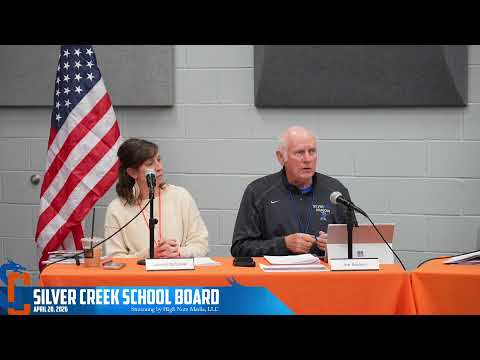
District finance staff told the Silver Creek School Corporation board on April 20 that rising property-tax ‘circuit breaker’ credits and other pressures could cost the district more than $1 million in 2026 and escalate toward $2.2 million by 2028, and outlined near-term large expenditures.
Todd presented the district’s first-quarter financial snapshot to the Silver Creek School Corporation board on April 20, saying the education fund began the year with roughly $5.6 million and revenue through March stood at about $6.6 million while expenditures are tracking at about 24.2% of appropriations.
“That’s where you want to sit,” Todd said, noting the district was under the 25% guideline but faces several large upcoming payments. He identified near-term obligations including three processor payments (roughly $350,000), employer contributions to retirement and VEBA plans (about $550,000), Chromebook purchases (about $350,000) and science textbooks (about $150,000).
Todd warned that those costs, combined with falling enrollment and statutory changes, will put pressure on reserves. He said the district’s rainy day fund currently holds about $1,272,324.50, roughly 3% of the budget, well under the recommended 15%.
The central focus of the presentation was Indiana’s property-tax “circuit breaker,” a set of caps that limit property-tax bills (1% for primary residences, 2% for rentals/farmland and 3% for businesses). Todd explained that when a taxpayer’s bill is reduced because of the cap, the unpaid portion becomes a credit and jurisdictions—including school districts—do not collect that revenue.
“We were experiencing right at $136,000 in circuit breaker loss” in 2021, Todd said, and projected district circuit-breaker losses “to go to $1.4 [million]” in 2026, $1.6 million in 2027 and $2.2 million in 2028 if current trends hold. He said rising assessed values and tax-rate changes have driven the increase and that projecting losses is inherently uncertain because assessed values can change.
Todd described one strategy the district used to manage cash flows—reimbursing certain local expenditures from 2023 bond proceeds after review by bond counsel—and said legislators’ changes to local income tax timing and charter-school funding shifts will add further fiscal pressure. He recommended continued conservatism on the operation fund and close monitoring of enrollment and legislative changes.
Board members thanked Todd for the report and discussed the difficulty of building reserves while revenue streams are compressed. Mr. Basham urged residents with tax concerns to contact their county assessors to discuss assessment inconsistencies the board had observed.
The presentation concluded with no formal board action beyond receiving the report. The board approved the consent agenda and other routine motions by voice votes elsewhere on the agenda.