Get Full Government Meeting Transcripts, Videos, & Alerts Forever!
Get email alerts on the Surplus Assets topic
No spam. Unsubscribe anytime.
City manager recommends auction of 67 surplus vehicles, trailers and equipment
Summary
The city manager asked the finance and governance committee to recommend that City Council authorize the purchasing agent to dispose of 67 surplus vehicles and related equipment via public auction under City Code section 4-54b, citing vehicle ages (1987–2020), high mileage and major mechanical failures. No vote was recorded in the transcript; the next step is Council authorization.
The City manager told the Finance and Governance Committee that the city has identified 67 units of surplus vehicles, trailers and related equipment across multiple departments and recommended selling them at public auction to recover residual value and ensure a transparent disposition process.
The recommendation matters because the items—ranging in model year from 1987 to 2020 and including many vehicles with between 100,000 and 150,000 miles or more—often have mechanical problems that make repair uneconomic. "These assets span model years from 1987 to 2020," the City manager said, "many of these vehicles have accumulated between 100,000 and 150,000 miles or more. Several are experiencing major mechanical issues, including engine failure, transmission failure and internal damage." The manager added that some units are accident-damaged, designated for part-out or fully nonoperational.
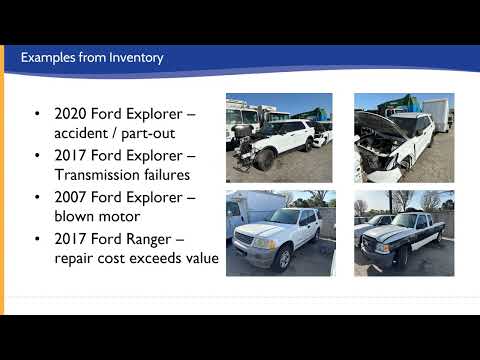
The presentation said the inventory includes a mix of standard fleet vehicles and specialized units. "The list also includes trailers, service units like flatbeds and box trucks and some specialized operational equipment," the City manager said, and cited examples including a 2020 Ford Explorer designated for part out, a 2017 Ford Explorer with transmission failure, a 2007 Ford Explorer with a blown motor and a 2017 Ford Ranger with repair costs exceeding its value.
Fleet services reviewed each unit and considered reassignment to other departments before recommending disposal. The manager said life-cycle costs were evaluated and, where reassignment or repair was not cost effective, removal from service was recommended. The presenter emphasized that the auction process is intended to establish fair market value through open competition and to provide a standardized, defensible method of disposal handled by a third-party vendor.
The formal recommendation presented to the committee was that it "recommend the City Council authorize the purchasing agent to dispose of 67 units of surplus trailers and equipment via public auction in accordance with City Code section 4-54b," the manager said. The transcript records the presentation and the recommendation but does not record any committee vote or formal action on the recommendation; the next procedural step, as stated in the presentation, is City Council consideration and authorization under the cited code.
Details the committee received include the departmental sources of the units (police, fire, water, streets and parks), the model-year range (1987–2020), the mileage band described by staff (generally 100,000–150,000+ miles), and examples of mechanical issues. No financial estimate of expected auction proceeds was provided in the transcript, and no vote or motion result was recorded. The manager closed the presentation by offering to take questions from the committee.