Get Full Government Meeting Transcripts, Videos, & Alerts Forever!
Get email alerts on the Healthcare Medicaid topic
No spam. Unsubscribe anytime.
Senate panel advances Medical Assistance Protection Act after debate on subpoenas and data access
Summary
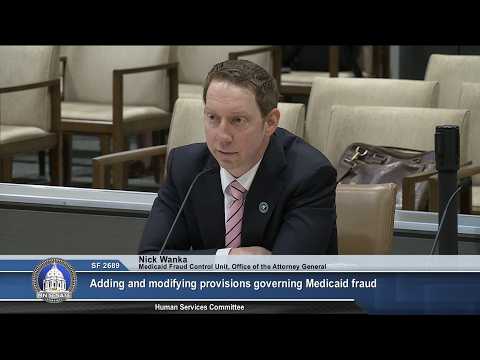
The Minnesota Senate Human Services Committee advanced Senate File 2689, which would add staff to the Attorney General's Medicaid Fraud Control Unit and expand criminal provisions and subpoena authority limited to Medicaid fraud investigations; the committee approved two amendments and referred Chapter 13 data-language to Judiciary for further work.
Senate File 2689, the Medical Assistance Protection Act, was advanced by the Minnesota Senate Human Services Committee on a voice vote after hours of testimony and debate over staffing, criminal standards and what data the Attorney General's Office must make public.
Sponsor Senator Sievers opened the hearing by describing the bill's aim. "I am here to present Senate File 2689, the Medical Assistance Protection Act," he said, placing the bill's goals squarely on protecting the Medical Assistance program that a large share of Minnesotans depend on.
The bill would increase the Attorney General's Medicaid Fraud Control Unit from 32 to 50 staff by adding 18 positions, alter several fraud-related statutes to broaden how provider misconduct can be prosecuted, create a separate penalty tier for frauds exceeding $1 million and grant subpoena powers to the Attorney General's Medicaid fraud investigators limited to financial records in Medicaid fraud probes. Mr. Walker, director of the Medicaid Fraud Control Unit, told the committee the unit has received a sharp increase in referrals and needs more investigators and prosecutors to keep pace: "we've already received over 300 separate referrals," he said, and urged the committee to fund the state share so the federal 75% match can be tapped.
Committee members pressed witnesses on safeguards to avoid criminalizing clerical or administrative errors. Mr. Walker and others said the bill requires proof of specific intent to defraud (mens rea) before criminal charges could stick and that the unit and the Department of Human Services will continue and expand provider education programs to reduce preventable mistakes.
Separately, the panel considered Amendment 13, introduced by Senator Rasmussen, which would clarify how data held by the Attorney General's Office is classified under Minnesota's data-practices law. "The intent of this amendment is to bring more transparency to the Office of Attorney General," Rasmussen said, arguing the amendment restores parity after a 2022 Minnesota Supreme Court ruling. Oliver Larson of the AG's office testified that much of the data in the Medicaid fraud section would remain classified under law-enforcement provisions and warned the amendment could have enterprise-wide effects that extend beyond Medicaid, including on antitrust and policy-related complaints.
Both Amendment 14 (a fiscal-clarifying amendment) and Amendment 13 were approved on voice votes. The committee then recommended Senate File 2689 as amended and referred the bill to the Judiciary Committee for further attention to Chapter 13 and data-classification language.
The committee record shows no roll-call tallies on the amendments or the final recommendation; votes were taken by voice. The hearing concluded with senators asking the Attorney General's Office and DHS to continue work on implementation details, particularly around provider outreach, documentation costs and the standard of proof for criminal charges.
Next steps: Senate File 2689 was sent to the Judiciary Committee for additional consideration of the data-practices language and any technical statutory fixes; committee sponsors and AG staff said they will continue discussions and brief lawmakers on fiscal and rollout details.