Get Full Government Meeting Transcripts, Videos, & Alerts Forever!
Get email alerts on the Public Safety Budget topic
No spam. Unsubscribe anytime.
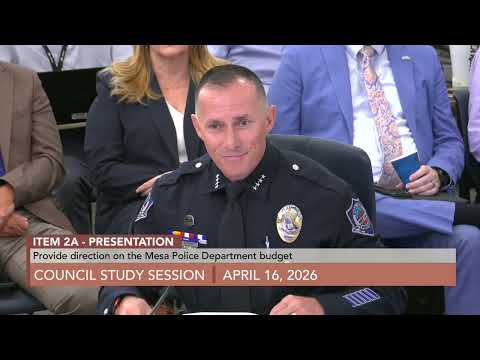
Mesa police present $290M budget plan, propose six sworn reductions, civilianization and tighter spending
Summary
Mesa Police Department presented its FY26/27 budget (~$290 million before carryovers), highlighted crime reductions and traffic enforcement gains, and proposed $1.7 million in reductions including elimination of a recruit signing bonus, three sworn positions moved/reassigned and civilianization of three roles; council asked for more district crash data and quarterly fatality reports.
The Mesa Police Department presented a proposed FY26/27 budget to the City Council on April 16 that department leaders said is designed to sustain crime‑prevention programs while tightening some expenditures.
Police Chief Dan Butler told council the department’s mission is “to provide professional policing that prevents crime while creating a safe and thriving community,” and framed the department’s budget requests around strategic staffing, leadership development and community engagement. He said the budget will sustain programs the department credits for documented public‑safety outcomes in 2025, including officers’ life‑saving actions and the department’s Narcan deployments.
Butler and other command staff emphasized both metrics and context. The department reported that Mesa’s comparative Group A crime rate remains low versus peer cities and that 2025 produced a roughly 14% reduction in violent crime, while some Group A person‑crime categories rose as a byproduct of targeted enforcement and increased arrests. “When we bring proactive operations into an area, we sometimes see reported crime counts go up because we’re documenting and arresting activity that otherwise went unnoticed,” Chief Tim Walker said.
Traffic safety was a central part of the presentation. Assistant Chief Aaron Spicer described a roughly 5% year‑over‑year increase in total collisions and a slight increase in fatalities; PD has expanded traffic enforcement (adding six motor officers), increased written warnings and DUI arrests and rolled out educational programs. Spicer said the department is pairing enforcement with engineering and education and urged continued coordination with transportation staff on street‑design fixes.
On cost‑cutting, fiscal manager Chrisa York said PD’s total FY27 budget is about $290 million prior to carryovers. The department proposed roughly $1.7 million in targeted reductions, including eliminating a recruit signing bonus (estimated $315,000), reducing project management/CCTV central funding (shifting costs to requesting departments), civilianizing three sworn roles to create three civilian positions (estimated $152,000 in savings), and holding several vacant professional positions open. Assistant Chief Jeff Cutler described a reorganization of a crime‑gun intelligence unit that would reassign three detectives into other vacancies while professional analysts take on case analysis; staff said functionality will continue but the headcount reported as sworn positions will decline by three.
Chief Butler and staff stressed the city’s pipeline and training cadence for sworn hires: Mesa is using an overhire pipeline (125 recruits beyond the authorized 845 sworn positions) so new hires can be trained and available when retirements occur; it typically takes roughly 11 months to bring a recruit to solo patrol status. Butler emphasized that the pipeline has helped stabilize staffing but acknowledged long‑term pressures on pension/benchmarks and personnel costs.
The presentation also covered overtime trends. PD showed multi‑year declines in overtime hours and reported being approximately $3–4 million over overtime budget while stressing the department has tightened controls and scheduling to reduce reliance on overtime.
On staffing and parks, council members asked about eliminating three vacant park ranger positions; PD explained recent program adjustments (scheduling, cameras and a sworn supervisor) reduced immediate need for some ranger slots but said staffing will be monitored and could be restored if necessary.
The presentation concluded with staff offering to provide more granular crash data to council members (time‑of‑day, mode involved, and district‑level dot data) and with a reminder that some budget items (carryovers and final salary/merit proposals) will be reflected in the June adoption process.
What’s next: Council requested quarterly or semiannual fatality and crash reports and additional district‑level data; the PD budget will return as part of the City’s broader FY27 budget adoption process.