Get Full Government Meeting Transcripts, Videos, & Alerts Forever!
Get email alerts on the Housing topic
No spam. Unsubscribe anytime.
Alamosa City work session weighs stricter enforcement for problem properties, allows staff discretion on non-life-safety issues
Summary
City staff outlined categories of problem properties and proposed fines, liens and limited use of city funds to remediate nuisance but structurally sound homes. Council signaled support for stricter action on vacant and bank-owned lots, more staff discretion for non-life-safety issues, and asked staff to research legal acquisition and funding options.
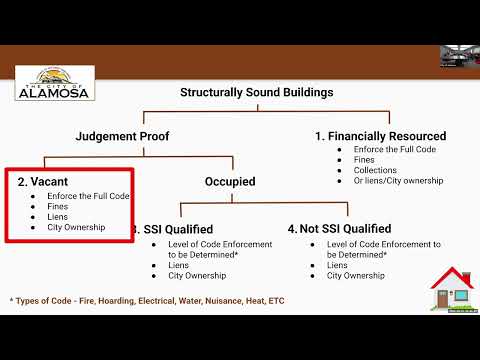
City staff presented the Alamosa City Council with a framework for addressing nuisance properties that are structurally sound but fail portions of the International Property Maintenance Code, asking for guidance on where to draw the line between strict enforcement and discretion for residents with limited means.
The presentation, led by city staff, laid out four enforcement categories — financially resourced owners, judgment‑proof owners, vacant properties and occupied properties with limited resources — and recommended different remedies for each. Staff urged council to prioritize life‑safety threats such as exposed wiring, blocked egress and fire‑risk hoarding while allowing more flexibility on lower‑risk items such as hot water or exterior aesthetics.
"We're not trying to collect fees. We're not trying to make money. We just want the neighborhoods to be better, the houses to be better, people to be safer," said the staff presenter, summarizing the enforcement goals and explaining why fines and liens were presented as tools to motivate compliance. The presenter stressed that the discussion condensed lengthy code text, including habitability thresholds such as maintaining a 68°F continuous heat source, functioning plumbing and safe electrical systems.
Staff described existing municipal approaches: fines for weeds, trash and rubbish (first offense $500; second offense $1,000) are already super‑priority liens that the city can certify to the county treasurer, while fines for building‑code violations are not currently set to fixed amounts. Staff recommended adopting a fine schedule for property‑code violations that could mirror the nuisance fine schedule and clarified that contractor cleanups performed by the city commonly cost $5,000–$10,000 per event.
Councilors pressed staff on specific items. Councilor Jackie Vill said she would hesitate to enforce central‑heating requirements on households that rely on wood stoves, while endorsing enforcement of clear fire risks: "Space heaters are scary — that’s a fire hazard — so I think that should be enforced," she said. Captain Burch, representing fire department concerns, voiced frustration with recurring problem properties and asked rhetorically, "Can't we tear them down?" — a question staff said the city cannot ethically answer when structures are structurally sound.
On vacant and bank‑owned properties, councilors generally supported more aggressive enforcement. Staff noted that vacant properties and bank‑owned lots often harm neighborhood housing supply and are more straightforward to remediate with liens and tax‑foreclosure processes than occupied homes. For occupied homes, councilors repeatedly urged compassion for low‑income and SSI‑eligible residents, asking that staff pursue repairs and help programs where possible before recommending lien or foreclosure steps.
Councilors and staff discussed several legal and fiscal constraints. Staff highlighted the risk of spending public money where a mortgage exists because a mortgage can have superior lien priority, meaning the city might not recoup remediation costs. As a starting rule, staff suggested checking mortgages and assessor values before authorizing large expenditures and discussed a placeholder cap (for discussion) of spending no more than a percentage of assessor value to limit city exposure.
Rather than voting on an ordinance, council asked staff to return with more research. The council signaled support for two principal directions: enforce the full code and pursue fines/liens for vacant and clearly financially resourced properties; and give staff clearer authority and discretion to treat non‑life‑safety items with leniency where appropriate, coupled with guidance on thresholds. The council also asked staff to research potential acquisition mechanisms, 'soft exit' buyout options for persistent cases involving severe hoarding or mental‑health barriers, and whether any legal tools resembling eminent‑domain or other acquisition paths could be adapted for nuisance remediation.
No formal motions or votes were taken during the work session. Staff said it would develop recommended code language, a fine schedule, and legal options for council consideration at a future meeting.
The city’s International Property Maintenance Code requirements, municipal court timelines and the practical costs of contractor cleanups were central to the debate; council members asked staff to prioritize further work on funding options and legal mechanisms so the council can consider ordinance changes at a later date.