Get Full Government Meeting Transcripts, Videos, & Alerts Forever!
Get email alerts on the Participatory Budgeting topic
No spam. Unsubscribe anytime.
Boston City Council committee reviews participatory budgeting office's FY27 request as members debate outreach and youth voting
Summary
The Ways & Means committee heard an update from the Office of Participatory Budgeting on April 23, 2026: director Renata Costello detailed participation metrics and implementation progress, and councilors pressed on a roughly 11% budget cut, neighborhood outreach and whether voters as young as 11 should decide PB allocations.
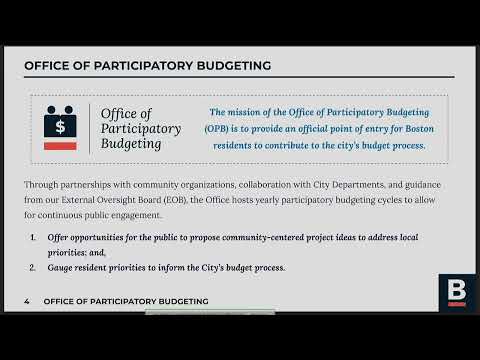
Renata Costello, director of the Office of Participatory Budgeting, told the Boston City Council Committee on Ways & Means on April 23 that the office collected more than 1,200 project ideas citywide and received more than 4,800 votes in the most recent cycle. "We collected over 1,200 ideas from residents across the city," Costello said during a presentation to the committee, describing idea-collection, proposal-development and voting phases designed to give residents a direct say in how part of the city's budget is spent.
The presentation summarized two years of the program: the office contracts with community organizations to run outreach, hosted 31 events and five in-person proposal-development forums, and reported that eight winning proposals from the last ballot received a combined $2.2 million. Costello said two projects from the first cycle are complete, including a youth tenant stabilization fund that supported 54 households, and that procurement is underway for 120 bus-stop benches slated for installation in the fall.
Costello said the office's FY27 recommended operating budget is about $1.88 million and that the proposal represents an approximate 11.4% decrease from FY26. She attributed the reduction primarily to a reclassification of the chief-of-staff role to a coordinator-level position and to a lower special-appropriations line. "Part of the decrease came through a reclassification of one of the roles in the department," she said, adding that prior-year balances were rolled into a continuous fund that will allow about $2 million of project awards in the upcoming cycle.
Councilors used the hearing to press on specifics. Councilor Flynn asked for comparative figures and for the salary impacts of the reclassification; Costello provided prior-cycle totals (about $2,130,000 and $2,134,250 for recent years) and said she would follow up with exact salary numbers. Flynn also asked whether outreach included veterans or military families; Costello said the office used citywide communications and partner organizations for targeted outreach but did not identify a specific veterans-focused campaign in the last cycle.
Councilor Culpepper urged expanding the program and suggested a much larger funding goal: "I've always said that this budget should be increased from the $2 million to $10 million," he said, arguing for at least one project opportunity per council district. Costello said program expansion would require greater staff capacity and additional contracting dollars because the office relies on nonprofit partners and external contractors to run localized outreach and events.
Several councilors praised the program's civic-engagement outcomes while also probing how ideas become implementable. Costello described the office's multi-stage checks: early eligibility screening, proposal-development meetings with departments, and review by legal, procurement and budget teams to ensure proposals on the ballot are feasible to implement. On implementation timelines she said departments will receive line items from a special revenue fund and can draw funds when ready; the office holds recurring check-ins with departments to track milestones.
The office's participation data was a focal point. Costello said younger residents were strongly represented in earlier phases: about 22% of participants in idea collection and proposal development were ages 11 to 19, while roughly 8% of final voters were in that bracket. That allowance for 11'year-olds to vote drew criticism from at least one councilor, who said during the hearing that 11- and 12-year-olds should not be deciding allocations of taxpayer funds; other councilors defended youth engagement as an investment in civic education and noted that youths participate in forums alongside older residents before proposals reach the ballot.
Councilors also questioned geographic reach and equity of outreach. Members asked whether the office's 19 contracted nonprofit partners and the five proposal-development forums adequately covered neighborhoods including Roxbury and Dorchester. Costello said the office rotates forum locations each cycle, contracts with community groups across neighborhoods, and will provide a list of partner organizations and event locations on request. Several members urged sustained contracting dollars so outreach capacity does not decline.
No formal votes were taken during the hearing. The committee closed after members and the director discussed next steps: Costello said a fuller report on the cycle will be published in June 2026 and that departments should be able to access PB funds within the fiscal year to begin implementation. Chair Ben Weber adjourned the meeting after thanking staff and attendees.
What happens next: The office plans to finalize a detailed report in June and continue monthly or bimonthly check-ins with implementing departments; councilors signaled interest in reviewing partner lists and district-level outreach plans before deciding on any budget changes.