Get Full Government Meeting Transcripts, Videos, & Alerts Forever!
Get email alerts on the Parking Policy topic
No spam. Unsubscribe anytime.
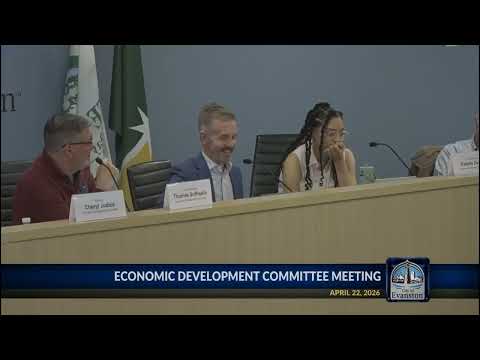
Evanston committee weighs two-hour free parking as staff warns of $5.1 million annual hit
Summary
The Evanston Economic Development Committee debated offering two-hour free business-district parking after staff estimated a $5.1 million yearly revenue loss. Members asked staff to return with vendor usage data, a business survey, dynamic-pricing options and a plan to prioritize downtown wayfinding.
The Evanston Economic Development Committee opened a broad discussion on parking policy after staff estimated that eliminating parking fees across business districts would cost the city about $5.1 million a year.
Paul, a department staff member presenting the analysis, told the committee that "providing free parking results in a estimated $5.1 million loss in revenue on an annual basis," and cautioned that local retail sales tax would be unlikely to recoup that shortfall. Mr. Rivera, the administrative services director, added that "even if we eliminate the fees, you still have a cost structure in place to enforce the time limits" and that enforcement and vendor fees would continue to create expenses for the city.
Why it matters: Committee members framed the question as a trade-off between customer convenience and municipal finance. Several members said parking is an important tool for supporting retail vibrancy but noted that bluntly removing fees could increase congestion, enforcement burdens and long-term costs. One committee member, citing parking research, summarized a central policy tension: "free parking isn't free," because it can encourage cruising, car dependence and lost turnover for street-level businesses.
Key details and differing views: Council Member Davis asked whether shorter free-stay options—15 or 30 minutes—could address quick pick-ups without large revenue losses; staff said median paid sessions were typically in the one- to two-hour range and that vendor reports can, with proper zone coding, show session durations by zone. Several members proposed targeted, district-level approaches rather than citywide blanket free parking: options discussed included stricter short-stay limits on high-turnover street parking, dynamic pricing that shifts by hour and demand, dedicating meter revenue to the generating district, and improved wayfinding to encourage use of underutilized garages.
Staff also described previous holiday pilots: the city’s multi-week free-parking promotion generates measurable utilization but extrapolating that approach year-round could cost more than $1.3 million (staff cautioned that utilization can ramp up over time, increasing the fiscal impact if a program becomes popular).
Next steps: The committee directed staff to return with more granular evidence and options. Specifically, members asked for: vendor-supplied utilization and session-duration data (Passport and other vendors), a business survey (SSAs/business districts) on parking needs, block- or district-level correlation where possible between parking utilization and sales tax, an investigation into dynamic pricing feasibility with current vendors, and an operational plan for low-friction payment or prepaid options. Council Member Davis also asked staff to prioritize downtown wayfinding signage to improve garage visibility; staff treated that as a direction for budgeting and implementation planning.
What to watch: Staff said they would report back with a combination of (a) targeted block-level analyses, (b) business-survey results, and (c) vendor feasibility on dynamic pricing or prepaid passes. Any formal policy change would require additional budget review because of the projected multi-million-dollar revenue implications.