Get Full Government Meeting Transcripts, Videos, & Alerts Forever!
Get email alerts on the Site Law Permitting topic
No spam. Unsubscribe anytime.
Maine DEP explains site law triggers, 'magic number' of one acre and 'no adverse effect' standard
Summary
At a Municipal Planning Assistance webinar, DEP senior environmental engineer Kareem Gungor explained how Maine's site location of development act and stormwater law apply: a one‑acre disturbance often triggers permitting, structures over three acres or large subdivisions require site‑law review, and projects must demonstrate 'no adverse effect' on natural resources.
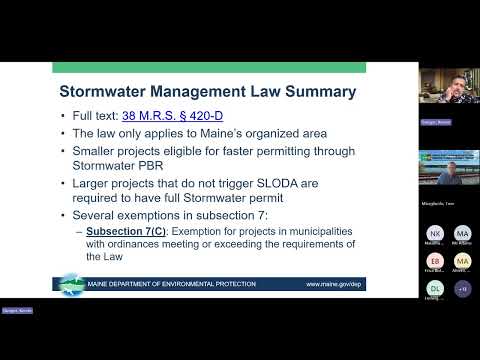
Kareem Gungor, senior environmental engineer with the Maine Department of Environmental Protection’s Bureau of Land Resources, told attendees at a Municipal Planning Assistance webinar that permitting typically begins at “the magic number of 1 acre of soil disturbance.” Gungor said that disturbing one acre or more generally triggers federal and state requirements — a construction general permit (MCGP) under the Clean Water Act and at minimum a stormwater permit‑by‑rule (SWPBR) or a full stormwater permit.
The explanation focused on how stormwater law and the Site Location of Development Act (commonly called site law) intersect. Gungor said site law requires developments to produce “no adverse effect on the natural environment,” and that site‑law review covers multiple standards including stormwater, surface and groundwater, buffers, noise, historic and scenic character, and wildlife and fisheries. “A developer has to make adequate provision for fitting the development harmoniously into the existing environment and not adversely affect existing users, scenic character, air quality, water quality, or other natural resources,” he said.
Gungor outlined specific jurisdictional thresholds under site law: projects that create three or more acres of structures (used by DEP to mean impervious area) require a site‑law permit; single‑family subdivisions reach site‑law review at 15 or more lots or 30 or more acres; other subdivisions are triggered at five or more lots or 20 or more acres. He also noted stormwater thresholds that can trigger a full stormwater permit — for example, creation of 20,000 square feet or more of impervious surface or development of five acres or more in at‑risk lake or urban‑impaired stream watersheds.
Gungor cautioned that jurisdictional measures are cumulative: incremental additions of impervious area on the same parcel can eventually push a project over a threshold and require additional permitting. He also emphasized that many applicants must show financial and technical capacity — demonstrating funds and qualified personnel to meet pollution‑control standards and operate post‑construction conditions such as recurring stormwater system recertification every five years.
The webinar included clarification questions from participants. On whether the single‑family threshold includes accessory dwellings, Gungor said the statute uses the term “detached” and recommended checking Chapter 500 for the precise definition. On whether standards apply during construction or only in operation, he said most standards are directed at operation, though construction‑phase impacts can prompt licensor review.
The presentation directed listeners to online resources for full text and referenced Chapter 500 as the rules that explain how stormwater law and site law apply to land‑development projects. Gungor also noted ongoing rulemaking: the department is working on a fourth major update to stormwater rules.