Get Full Government Meeting Transcripts, Videos, & Alerts Forever!
Get email alerts on the Budget And Levy topic
No spam. Unsubscribe anytime.
North St. Paul council agrees on 8% maximum levy target for 2026 budget
Summary
After a presentation from Finance Director Dan Winnick, North St. Paul councilors agreed to set a maximum levy target of 8% for 2026, directing staff to prepare resolutions that would add dedicated funds for parks, the community center and infrastructure while restoring part of an electric-penalty transfer.
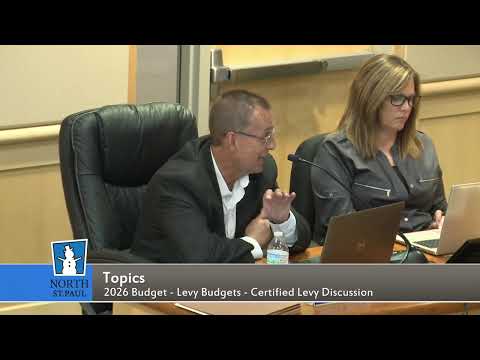
The North St. Paul City Council on Wednesday directed staff to prepare resolutions certifying a maximum levy target of 8% for the 2026 budget, after hearing a detailed presentation from Finance Director Dan Winnick about the city’s revenue mix and long-term infrastructure needs.
Winnick told the council the city’s proposed combined city/HRA/EDA maximum levy stands at 5.84% but that infrastructure and debt components built into the capital improvement plan are creating sustained pressure on property tax levels. “We’re at a 5.84% levy increase,” Winnick said, and warned that continuing the current CIP would effectively expose residents to much higher cumulative levy pressure in future years.
Why this matters: property taxes fund most city operations. Winnick estimated property taxes make up about 57% of general-fund revenue and that, with an assessor-estimated 2.41% median home-value increase, the combined levy package at 5.84% would translate to roughly a $38 annual increase for the median homeowner. He also highlighted that personnel and public-safety spending drive the majority of expenditures.
Council discussion centered on smoothing the city’s levy trajectory. Staff recommended three specific composition changes to reach an 8% maximum: add $30,000 to fully fund the parks CIP request; transfer $85,000 from debt funds to maintain current community-center operations; and dedicate the remaining levy increase to infrastructure. Council members also agreed to re-add approximately $65,000 of the electric-penalty transfer back into the levy package to ease future utility-rate and fund-balance tensions.
Council member Jason (last name as stated in the transcript) said splitting the difference on the electric-penalty transfer was a reasonable compromise to avoid raising electric utility rates after moving funds out of the enterprise fund. City staff described a $124,000 insurance reserve and a $512,000 balance in a debt-related fund available to cover some near-term facility needs without further levy increases.
The council reached consensus on the 8% maximum and directed staff to prepare the formal resolutions for the next council meeting; the resolutions must be certified to Ramsey County by the end of the month. Dan Winnick noted that the number is a maximum; the council can adopt a lower levy before final budget approval in December.
What comes next: staff will draft the certification resolutions and bring them back to the council for formal action. The council’s direction is procedural — it sets a maximum for certification — and does not itself finalize tax rates or the budget.