Get Full Government Meeting Transcripts, Videos, & Alerts Forever!
Get email alerts on the Sales Tax Exemption topic
No spam. Unsubscribe anytime.
Committee passes substitute to Senate Bill 52 to codify DOR guidance on sales-tax exemptions for interstate motor carriers
Summary
The Ways & Means Committee approved a house substitute to Senate Bill 52 (LC590465S) that codifies Department of Revenue policy clarifying which interstate motor carrier activity qualifies for a sales-tax exemption; committee members sought drafting and nexus clarifications before a voice vote passed the measure.
A house substitute to Senate Bill 52 (LC590465S) that codifies Department of Revenue (DOR) guidance on sales-tax exemptions for interstate motor carriers passed the Ways & Means Committee by voice vote.
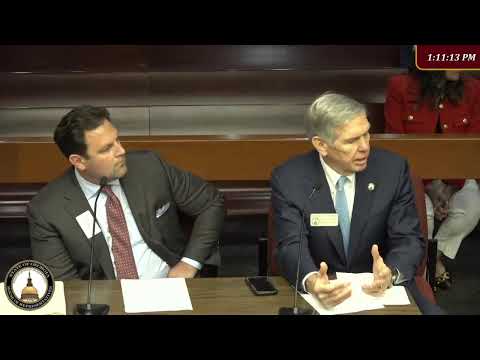
Chairman Williamson introduced the substitute, saying the measure would "clarify existing law on sales tax exemptions for interstate motor carriers" and replace the underlying bill language with the amendment before the committee. The sponsor told members the change is intended to reduce ambiguity for motor truckers about how to accrue and pay sales taxes on trucks, parts and repairs.
The committee spent most of its discussion asking how DOR will apply the clarified rule. Nathan Goolsby, with the Georgia Motor Trucking Association, told members the draft "codifies what [DOR] has as sort of an internal policy" and deferred technical questions to department staff. Joe Snowden, with the Department of Revenue, said the department worked with the sponsor and seeks to put existing internal approval criteria into statute: "They've come and asked us to basically codify what we have as sort of an internal policy," he said, adding that the language reflects the factors DOR uses to determine qualification for the exemption as industry practices evolve.
Several members pressed whether the bill requires a majority of miles to be traveled out of state or instead looks for a nexus to other states. A member described a hypothetical Albany-based carrier that conducts most road miles inside Georgia but has interstate stops; members and DOR representatives agreed the review centers on the existence of a nexus to other states rather than a strict external-mileage threshold, though one member warned that line 19's phrasing ("shall not be construed to require") creates a double-negative that could be clearer.
Representative Camp asked whether Georgia trucking companies in Savannah, Augusta and other cities could aggregate miles for the deduction; the sponsor confirmed they are Georgia businesses and that the substitute is intended to allow cumulative mileage to be considered under the clarified rule. Representative Cannon asked about fiscal impact; the sponsor said there was none and that the substitute is a codification of existing practice rather than a new exemption.
After questions, a motion and second were followed by a voice vote. The committee chair called for those in favor to "signify by stating I;" members responded and the chair said, "It all passes." The Ways & Means Committee then adjourned.
The measure will proceed according to the Legislature's committee and floor scheduling rules.