Get Full Government Meeting Transcripts, Videos, & Alerts Forever!
Get email alerts on the Foreign Policy topic
No spam. Unsubscribe anytime.
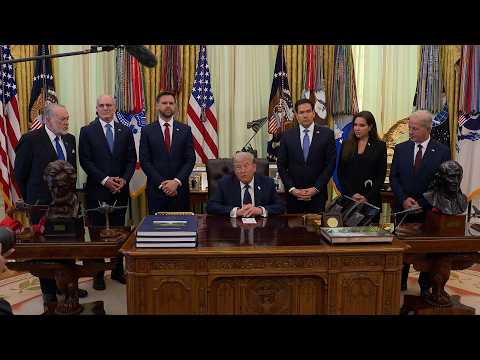
U.S. hosts Lebanon and Israel envoys and announces three‑week ceasefire extension
Summary
At a White House event, the president said Israeli and Lebanese leaders had agreed to extend a ceasefire for three weeks and praised U.S. diplomacy; reporters pressed for details on Hezbollah, Iran's role and planned visits by the countries' leaders.
The president called a meeting between Israeli and Lebanese officials "historic," saying the leaders "have agreed to an additional three weeks" of ceasefire and expressing optimism that talks could lead toward permanent peace. "We think that the president of Lebanon and the prime minister of Israel over the next couple of weeks will be coming here," he said.
The vice president, addressed in the remarks as "JD," described the moment as "a major historic moment" and credited the president's direct engagement and U.S. diplomacy for the pause. "We're going to extend the ceasefire for 3 weeks that's already in place between Israel and Lebanon," JD said, calling it an opening for further work.
Speakers at the event repeatedly identified Hezbollah as the central obstacle to a lasting settlement. A participant identified in the transcript as Mike Huckabe said Lebanon and Israel are "neighbors and they want to get along" but called Hezbollah the disruptive actor "throwing rocks at everybody's window." The president echoed that view, saying Iran would need to cut funding that reaches Hezbollah for a deal to hold: "Yeah, they'll have to cut. That's a must."
A Lebanese ambassador attending the meeting thanked the United States for its role and said U.S. backing could help "make Lebanon great again." The president praised the U.S. ambassador to Lebanon and said the administration would "work with Lebanon to get things straightened out in that country."
Reporters asked whether Israeli and Lebanese leaders would meet at the White House during the three-week pause; the president said he thought they were likely to come and characterized the pause as an opportunity to press for a larger diplomatic settlement. He also acknowledged a domestic legal barrier in Lebanon raised by a reporter — that Lebanese law can criminalize contact with Israel — and said "we have to end that," calling it "crazy."
The administration did not enumerate specific security assistance packages in the event. On questions about what "working with Lebanon" would mean in material terms, the president responded generally, "We're going to help them... we're going to work together," without detailing equipment, timelines or conditionalities.
The meeting closed with the president and other U.S. officials continuing to cast the three‑week extension as a stepping stone to further diplomacy rather than as a final settlement. The president said he was optimistic a more formal meeting and progress would follow during the pause.