Get Full Government Meeting Transcripts, Videos, & Alerts Forever!
Get email alerts on the Inclusionary Housing topic
No spam. Unsubscribe anytime.
West Hollywood studies rewrite of inclusionary housing rules; staff backs mixed-income option
Summary
City staff and consultants presented options for updating West Hollywood's inclusionary housing ordinance, recommending a mixed-income approach (Option D) to meet RHNA goals while balancing project feasibility; Council asked staff for pipeline data, peer comparisons and funding alternatives before final ordinance language is returned.
West Hollywood City Council held a study session to review options for updating its inclusionary housing ordinance and asked staff to return with ordinance language, zoning amendments and further analysis.
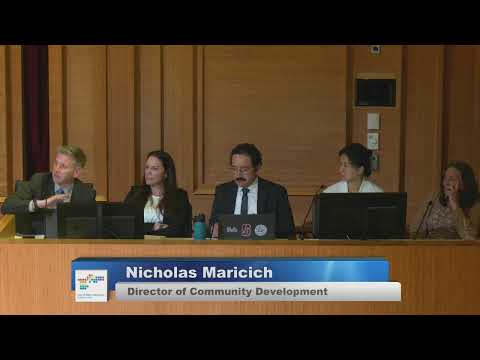
City staff and consultants presented a suite of policy options (A through E) that translate local set-asides into HCD income bands and test how state density bonus incentives affect feasibility. Staff recommended Option D, which mixes extremely low-, very low- and low-income set-asides and uses a local density bonus to account for a 5% low-income component that does not qualify for state stacking. Francisco Contreras, Long Range Planning Manager, said the session's purpose was to "review the policy framework, consider the key tradeoffs, hear outside perspectives and public comment, and receive Council's high-level direction before staff returns with a refined ordinance update and related zoning amendments."
Why it matters: consultants stressed that inclusionary requirements are a trade-off between more below-market units and the risk of reducing overall production. Shane Phillips of UCLA's Lewis Center said his modeling shows that "regardless of the scenario selected from 1% to 40%, you're always losing at least four market rate units for each below market rate unit that you gain," and that in his simulations affordable-unit yield peaks near a 25% requirement before declining. The consultants and staff framed density bonuses as the principal offset: when paired with a substantial state density bonus, many inclusionary scenarios remain feasible.
Key details and council reaction: staff outlined a baseline that for 11-plus unit projects had previously recommended 20% inclusionary with a rental affordability mix of 5% extremely low income (ELI), 10% very low income (VLI), and 5% low income (LI). The options presented include:
- Option A/B: translate the city's Schedule A to HCD limits and provide pathways for a portion of the requirement to be met by in-lieu fees; A targets ELI and B targets VLI. - Option C: align with state density-bonus stacking to qualify for a larger (70%) bonus by shifting some set-asides upward. - Option D (staff preferred): combine ELI, VLI and LI set-asides to better match RHNA needs and use a local density bonus to compensate for the extra 5% LI. - Option E: tests a 25% requirement but was not recommended under current market conditions.
Councilmembers pressed staff on practical trade-offs. Councilmember Byers said the city should explore a "funded inclusionary housing model" to direct public subsidy and get on-site units more quickly rather than relying exclusively on in-lieu fees; Byers told colleagues, "I'm really interested in a funded inclusionary housing model and where we as a city would start looking at something like that." Councilmember Erickson bluntly asked whether the city would meet its RHNA targets, stating, "we will not hit our RHNA numbers, correct?" Staff responded that West Hollywood is behind on RHNA progress and later provided figures: an earlier annual report figure cited ~10% progress, while staff updated Council that 2025 progress measured about 18% toward current cycle targets.
Small-project rules and trust-fund trade-offs: staff recommended retaining fee-based compliance for two-to-four unit projects and moving to a must-build 15% requirement for five-to-ten unit projects (with in-lieu fees allowed for fractional remainders). Consultants noted that between 2020 and 2024 the city collected about $1.4 million in residential in-lieu fees and that local subsidy averaged roughly $115,000 per unit in recent years when used to produce 100% affordable projects, illustrating the trade-off between immediate on-site units and poolable subsidy that can fund deeper affordability through larger projects.
Next steps: Council did not take a final vote. Members generally signaled support for Option D as a starting point but asked staff to return with: a refined ordinance and zoning amendments, a pipeline breakdown (which staff said is tracking ~2,000 proposed units citywide, with ~827 on Santa Monica Boulevard and ~133 of those proposed as affordable), a peer-city comparison appendix, and options for funding or subsidizing inclusionary units. The study session adjourned with staff assigned to return with ordinance language, implementation details and additional analysis.
The study session included no formal motions or votes; staff will bring any ordinance drafts and related actions back to Council for formal consideration.