Get Full Government Meeting Transcripts, Videos, & Alerts Forever!
Get email alerts on the Pretrial Services topic
No spam. Unsubscribe anytime.
Marshall County advisory board flags funding squeeze for pretrial services and community corrections
Summary
Board members heard that the county’s PI fund is covering most pretrial release costs after a planned Office of Court Services certification was withdrawn; staff warned Department of Corrections grant support is uncertain and noted recent staff moves and caseload statistics.
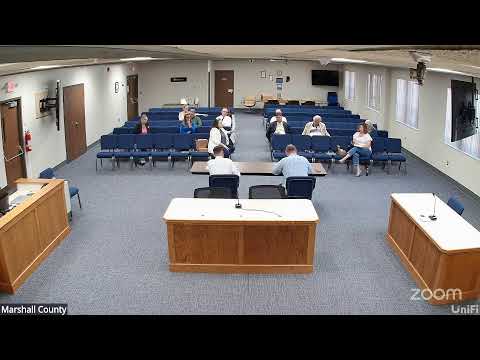
Marshall County’s Community Corrections Advisory Board on April 23 heard that pretrial services are under financial strain as the county absorbs costs after a planned certification and related grant funding changed.
An operations update presented quarterly program totals: 114 people on GPS monitoring and roughly 140 people enrolled in community corrections programs that include drug screening, ignition interlock, pretrial supervision and day reporting. Staff reported quarterly billing of 11,808 sent and 11,786 collected — the largest quarterly collection since 2024 — and said building and move expenses have driven higher year‑to‑date costs.
The board was told the PI (pretrial intervention) fund “has taken the most substantial hit” and is currently covering much of the county’s pretrial release officer cost. Staff said they have requested the Department of Corrections to include pretrial funding in an expanded DOC grant request but cautioned the DOC has signaled possible cuts and could decline the additional request, leaving the county to determine its own ongoing commitment.
Shelisa, who recently joined community corrections and has been in the office about two weeks, described day‑to‑day pretrial work and caseloads. "I moved there about two weeks ago and it's running really smooth. I enjoy it," she said, and reported reviewing 263 people last quarter with 212 assessments; 28 people were found eligible for services and eight were placed. Staff also reported seven revocations, seven bond assessments to determine eligibility for lower bond, 60 people who had bond reduced or had bond set after no bond, 20 released on their own recognizance and 15 who bonded out prior to assessment.
Probation staff said probation caseloads include about 620 adults and 59 juveniles (both reporting and non‑reporting cases). Probation is recruiting for a family support services counselor (open since September) and a recently vacated secretary position.
The sheriff briefed the board on staffing pressures in patrol: two officers were out on medical leave or light duty and recent hiring required multiple recruitment rounds because of low applicant pools and state personnel‑file sharing rules, leaving roughly a 20% shortfall on patrol at the time of the meeting.
Board members emphasized the link between community corrections and jail population: the county averaged 141 daily inmates in 2025 (about 60% of capacity), and members noted that when occupancy nears 80% the county is expected to plan for additional jail capacity to preserve separation space for safety.
No formal vote was taken. Board members said they expect further discussions with county council and DOC about the county’s funding role for pretrial services and signaled they will return with more detailed financial and caseload data at a future meeting.