Get Full Government Meeting Transcripts, Videos, & Alerts Forever!
Get email alerts on the General Sewer Plan topic
No spam. Unsubscribe anytime.
College Place planning commission recommends council adopt updated general sewer plan
Summary
The commission voted to recommend the city council adopt a 2026 general sewer plan update that prioritizes about $4.1 million in near-term projects (2026–2031), recommends lift-station communications and pump upgrades, and calls for condition assessment of a key trunk line to the wastewater treatment plant.
The College Place Planning Commission on April 21 voted to recommend the City Council adopt an update to the city’s general sewer plan, endorsing a prioritized 10‑year capital improvement program and a list of projects that would make those projects eligible for state funding once Ecology approves the plan.
Public works director Robert McAndrews introduced the staff presentation and said the plan identifies projects for rehabilitation, replacement and system expansion and helps the city seek grant or low‑interest loan funding. “Once a general sewer plan is approved by Ecology, the projects on it can go through the small community project priority list,” McAndrews said, referring to Ecology’s funding pathway.
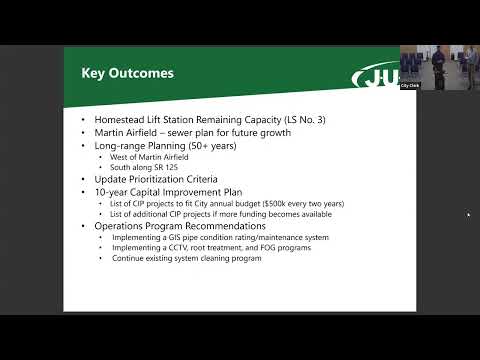
Consultants Alex Romero and Tyler French of JUB Engineering summarized key outcomes and priorities. They said the city’s first GSP, adopted in 2024, listed 37 projects and 24 of those were funded and completed recently for roughly $4.2 million, about half grant and half low‑interest loan. The new update, Romero said, focuses on anticipated growth toward Martin Airfield and other areas and on preparing durable infrastructure with a 50‑plus‑year expected service life.
The update ranks projects by a weighted evaluation of likelihood and consequence of failure and recommends near‑term work including: upgrading communications at several lift stations from aging landline callout systems to cellular‑based monitoring; replacing a failed pump at Homestead Lift Station (to maintain two pumps there); and performing a condition assessment of the large interceptor that carries wastewater to the treatment plant because “if that breaks … it could be catastrophic to the system,” Romero said.
Engineers presented a capital planning summary that puts about $4.1 million of prioritized work in the 2026–2031 window — a total that aligns with the city’s current capital facilities budget — and roughly $13.3 million of additional projects identified for later years subject to funding. Tyler French said the city historically raises rates by about 3–5% annually, and that a major rate increase to cover the $13.3 million was not anticipated at this time; a comprehensive rate study is planned for 2026–2027.
Commissioners asked several technical and policy questions. Commissioner Tan asked how old the system is; Romero answered much of the oldest infrastructure approaches 100 years, while newer PVC installations and lined pipe are expected to last 50–100 years after trenchless lining work. Commissioners also pressed on alternatives for serving future growth west of Martin Airfield and the tradeoff between open‑cut replacement and trenchless rehab; consultants said lining is generally preferred when conditions allow, and open replacement is used where upsizing or extreme damage is required.
No public comments were received during the hearing. Following discussion, a commissioner moved and another seconded a motion recommending that the council adopt the GSP update; the commission voted in favor and the motion passed.
Next steps include addressing Ecology’s review comments, incorporating any public comments, finalizing the plan, and presenting it to City Council for adoption so projects may proceed to funding and design.