Get Full Government Meeting Transcripts, Videos, & Alerts Forever!
Get email alerts on the Public Safety topic
No spam. Unsubscribe anytime.
Dubuque police outline staffing shortfalls, targeted raises and new retention packages in FY27 budget hearing
Summary
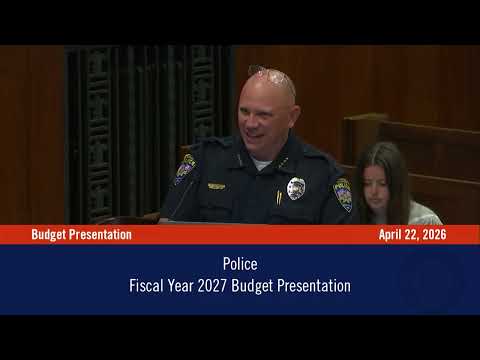
Assistant Chief Joe Messerich and Police Chief Jensen told the council the department is authorized for 109 sworn officers but is staffing 99, and proposed improvement packages including $40,000 for professional development and $11,400 to sustain officer wellness checks after a two‑year grant expires.
Assistant Chief Joe Messerich presented the Dubuque Police Department’s fiscal 2027 requests Tuesday, telling the City Council the department is authorized for 109 sworn positions but currently has 99 officers on staff, leaving 10 vacancies.
Messerich said the department negotiated a new contract in FY24 that expanded pay steps and this year proposes a 4% across‑the‑board raise with larger increases for senior steps to reach a target “50th percentile” in regional pay comparisons. He said the city will reopen contract talks for FY28 and FY29 to remain competitive.
The department asked for several improvement packages aimed at retention and training: $40,000 for a professional development package targeted at officers concluding four‑year contracts; a non‑recurring $11,400 request to fund annual wellness check‑ins with psychologists after a two‑year Law Enforcement Mental Health and Wellness Act grant ends; $5,000 to reimburse nonprofit event volunteers; and plans to repurpose $39,690 in vehicle sale revenue for training vehicles.
Chief Jensen framed technology and non‑sworn staff as “force multipliers,” describing the Precision Policing Center (PPC), a 22‑camera public safety network and automated license plate reader (ALPR) system used in multijurisdictional investigations. Jensen told council members the ALPR system “reads a plate, it reads a vehicle. It doesn’t read a person. It doesn’t track people,” and said officers must review hits before acting and that the department will align local policies with forthcoming state law updates.
Councilmembers pressed department leaders on how the new professional development funds differ from existing training budgets and on the expiration of several one‑time federal grants that boosted FY26 revenue. Messerich and Jensen confirmed some large federal grants—such as the two‑year mental‑health grant—are expiring and staff will pursue new grant opportunities while advising the council about likely recurring costs if grants are not renewed.
The police budget presentation listed net property tax support of $18,893,338 for the department and estimated the average homeowner share at $295.78.
The council also heard public comment praising the department’s community work and enforcement presence. Mayor Cavanagh and councilmembers thanked staff for recruitment efforts and emphasized the need to monitor wages to stay competitive with peer agencies.
Next steps: the council will consider the department’s improvement packages as part of the final FY27 budget adoption scheduled for the council’s upcoming public hearing and vote next week.