Get Full Government Meeting Transcripts, Videos, & Alerts Forever!
Get email alerts on the Clean Slate topic
No spam. Unsubscribe anytime.
Court subcommittee votes to recommend expanding clean‑slate exclusions to include additional family‑violence crimes
Summary
The court‑based subcommittee voted to recommend amending the state's clean‑slate statute (46B‑38H) to add a list of offenses the group considers family‑violence related—such as third‑degree assault and electronic stalking—and will include the recommendation in its June report to the full council.
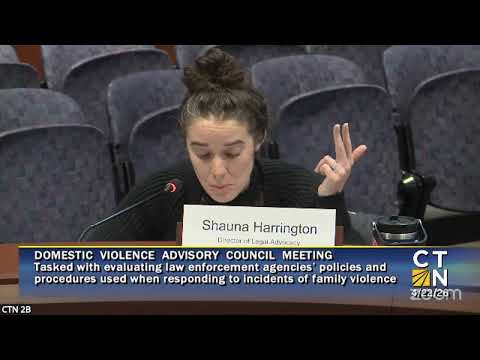
The court‑based issues subcommittee of the Connecticut Domestic Violence Council on April 22 advanced a recommendation to modify the state's "clean slate" statute so certain family‑violence offenses would be excluded from automated erasure.
Merit LeJoy, Office of the Victim Advocate, told the council the subcommittee reviewed the statute list in Conn. Gen. Stat. 46B‑38H and concluded several offenses commonly associated with family violence were not covered. The group voted by majority to recommend that the council propose statutory amendments in its June report.
LeJoy listed the offenses the subcommittee proposes be added to the exclusion list: assault third (Conn. Gen. Stat. 53A‑61); threatening first (53A‑61AA); unlawful restraint first and second (53A‑95, 53A‑96); custodial interference first and second (53A‑97, 53A‑98); criminal mischief first through third (53A‑115, 53A‑116, 53A‑117); electronic stalking (53A‑181F); interfering with an emergency call (53A‑183B); and violations of conditions of release (53A‑222, 53A‑222A). "We think the intent of the legislature was to exclude all crimes of family violence," LeJoy said, noting the list needs to be reconciled with statutory language.
The subcommittee also discussed related court‑process issues: whether victims should be notified when a protective order is modified or vacated, and the technical feasibility of using Vine (the notification platform) for post‑conviction notices; Office of Victim Services staff are researching Vine's capabilities before the subcommittee votes on that item. The group also discussed aligning confidentiality language in the Freedom of Information Act (Conn. Gen. Stat. 1‑210 and 1‑215) and plans to bring those recommendations forward at the June report.
Next steps: the court subcommittee will include the clean‑slate recommendation and any proposed FOI/confidentiality language in its June report to the full council; legislative liaisons (including Senator Flexer, who was noted as engaged in session this week) will be asked to help clarify legislative intent and coordinate follow‑up with affected parties.
Action recorded: the court‑based subcommittee voted, by majority, to advance the clean‑slate exclusion recommendation to the council for its June report.