Get Full Government Meeting Transcripts, Videos, & Alerts Forever!
Get email alerts on the Surveillance Law Enforcement topic
No spam. Unsubscribe anytime.
Bloomington council grills police chief on Flock license‑plate readers as contracts lapse
Summary
Police Chief Mike Deoff told the council the Bloomington Police Department used Flock license‑plate readers and related cameras to aid investigations but that the LPR contract was not renewed and external sharing has been turned off; council members and dozens of public commenters pressed for transparency, procurement records and immediate removal of vendor access.
Police Chief Mike Deoff told the Bloomington Common Council on April 22 that license‑plate reader (LPR) technology and related cameras have helped the department investigate serious crimes, but that the city is ending its contract for the LPR system. “The LPR system just ended,” Deoff said, adding that the stream to the vendor was turned off and outside sharing curtailed earlier this month.
Deoff outlined equipment currently used by the department: 11 permanently mounted LPR cameras on arterial routes, four permanently mounted downtown video cameras that record but are not monitored in real time, and several mobile trailers that can include video, LPR and gunshot‑detection technology. He said the department has restricted access to sworn officers and analysts, requires a case or event number and stated reason for each search, and performs internal audits every 60 days. Data retention is set at 30 days unless material in a criminal case.
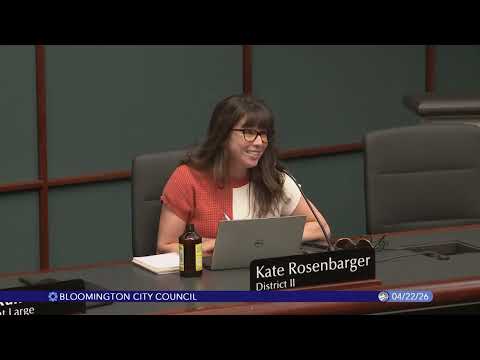
Council members pushed for details about procurement and vendor access. Council member Pedmont Smith asked which contracts had been terminated; Deoff said the LPR contract was not renewed and was scheduled to end at the end of the weekend. Council member Assari pressed Corporation Counsel Margie Rice and the chief on how a “sole‑source” designation was justified. Rice said sole‑source purchases are reviewed by the controller and legal, and “when there’s a unique product” a department can request that route.
A major portion of the meeting was devoted to public comment. Dozens of people spoke for up to three minutes each, with many urging the council and mayor to remove Flock cameras and not replace the system with another vendor. Speakers cited national reports of misuse, cloud‑storage concerns and the psychological harms of constant surveillance. “We don’t need continual expansion of the surveillance state,” one commenter said. Others, including local cybersecurity professionals, urged improved technical controls such as intrusion detection, better logging, and automated alerts.
Deoff said the department would research transparency portals other agencies use and investigate how to report aggregate uses without compromising active investigations. He also said some contracts for other camera systems remain in process, and that the mayor’s office and legal staff are working through the termination process. The council allowed an extended public comment period specifically on the Flock topic so residents could respond directly to the chief’s report.
What’s next: Deoff said his office and the mayor’s office plan to follow up on the remaining contracts and on what replacement technologies, if any, the city will purchase. The council has asked the administration for procurement records and additional written detail about access logs and audits.
Sources: Council meeting presentation and Q&A; public comment recorded during the April 22 council meeting.