Get Full Government Meeting Transcripts, Videos, & Alerts Forever!
Get email alerts on the Community Clean Energy topic
No spam. Unsubscribe anytime.
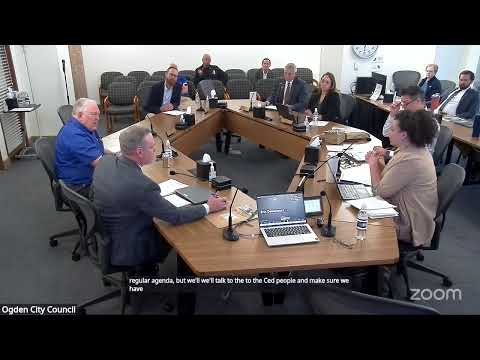
Ogden work session reviews community clean energy ordinance as June 2 decision deadline looms
Summary
At an April 21 work session, staff explained how the proposed ordinance would enroll Ogden customers by default into a countywide community clean energy program, that Rocky Mountain Power will front startup costs, and that the Public Service Commission will set program rates; council heard survey data showing roughly two‑to‑one initial support but many residents want more information on costs.
Ogden City Council discussed a draft ordinance on April 21 that would opt the city into the Utah community clean energy program authorized by HB411, placing most residential customers into a community renewable program by default while giving them an opt‑out. Lorenzo, the city staff presenter, told the council the ordinance "adopts everyone, all the customers into the program apart from those on schedule 135," and that individuals could opt out during the specified cancellation windows.
Why it matters: the program would add a new, itemized line on utility bills to collect rates meant to pay for community‑scale renewable energy resources and administrative costs. Staff emphasized the program’s potential to deliver utility‑scale renewables into the Rocky Mountain Power system quickly and at scale, and warned council the choice will affect billing and local outreach demands.
How the mechanics work: Emily Quinton, who participated remotely from Summit County, said Rocky Mountain Power will front the software and notice costs and place those expenditures into a balancing account to be repaid from program rate collections once the program begins. "Rocky Mountain Power will be essentially fronting those costs to do those upgrades and they'll be accounting for those costs in a balancing account, which then once the program launches and rates begin to be collected is the first thing that will be paid back," Emily Quinton said. Lorenzo added that Rocky Mountain Power must send two separate mailed notices and that implementation begins when the utility sends the first opt‑out notice — staff estimated roughly a five‑month lapse from adoption to full implementation.
Rates, modeling and consumer protections: Staff said the draft tariff models a roughly $3–$4 monthly range in early material presented to communities and that the program design includes resource reserves intended to stabilize rates over time. Lorenzo and Quinton described safeguards intended to prevent costs being shifted to non‑participants and noted the Public Service Commission (PSC) will ultimately determine the program rate. Council members repeatedly asked for the PSC docket and spreadsheets; staff said the PSC docket contains the modeling and other technical work.
Public sentiment: Kevin Lions of FlashVote presented a local survey panel that showed about a two‑to‑one favorable ratio toward a $4 monthly line item (roughly 58% "probably/definitely yes" vs about 27% "probably/definitely no"). Lions cautioned that an open, self‑selected sample (48‑hour open survey) skewed more negative, underlining the difference between a representative panel and public advocates who self‑mobilize to weigh in.
Concerns and responses: Council members raised several concerns, including a news article about PacificCorp's long‑range planning and whether that undercuts the program. Lorenzo responded that the community program would be a primary pathway for new renewables in the Rocky Mountain Power footprint: "If we want any renewable energy to be put on the grid, this is our chance. They're not going to do it themselves," he said. Council members also probed the possibility of including geothermal or nuclear resources; Lorenzo noted those technologies are allowed by statute but were not included in the initial procurement round because of timing and financing considerations.
Next steps: Staff said the council must act by June 2 to opt in; otherwise the city will not participate. Staff intends to place the ordinance on the council calendar for consideration and said additional public outreach and technical materials (PSC docket references and modeling spreadsheets) will be distributed to council members.
Editor’s note: Quotes and paraphrases in this article are drawn from the April 21, 2026 Ogden City Council work session transcript and staff presentations.