Get Full Government Meeting Transcripts, Videos, & Alerts Forever!
Get email alerts on the Telecom Tower topic
No spam. Unsubscribe anytime.
Council grants conditional waiver for proposed AT&T 195‑ft tower, requires planning review
Summary
After extended questioning about safety, neighbor consent and pending litigation, the Livingston Parish Council voted 4–3 to grant AT&T a conditional setback waiver for a proposed 195‑foot monopole at Bobby Gill Road, subject to planning and zoning sign‑off and further engineering documentation.
The Livingston Parish Council voted April 23 to grant AT&T a conditional waiver allowing the company to pursue site‑plan approval for a proposed 195‑foot monopole tower at Bobby Gill Road, but required the applicant to return to planning and zoning with finalized structural drawings and documentation before building permits are issued.
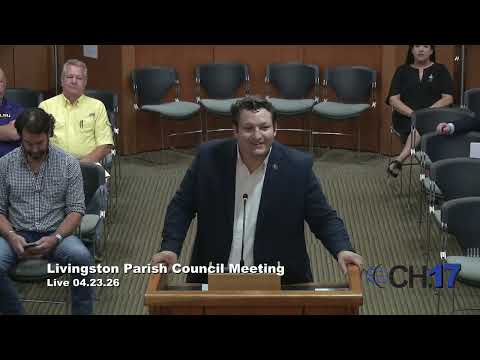
Chip Lions, the AT&T representative who appeared before the council, told members the company had submitted an engineering letter stating the tower would be designed with a “zero foot fall radius” and meet the structural standards added to the parish telecom ordinance last September. “We would respectfully request your support for the application,” Lions said, describing efforts to locate the facility and engineering steps to limit risk to adjacent properties.
The project’s central dispute was an updated parish ordinance provision that requires written consent from adjoining landowners for setback waivers. AT&T representatives said they had attempted to obtain that consent but one neighboring owner refused to sign. Council members pressed AT&T and parish staff on whether the submitted engineering documentation and a stamped engineer’s letter satisfied the ordinance’s safety standards and whether granting a waiver would leave the parish exposed to litigation.
Council members were divided. Supporters of a conditional approval said the company’s engineering documentation and the proposed zero‑fall design addressed the primary safety concern and that planning staff would not permit a structural design that failed to meet ordinance standards. Opponents said the new ordinance’s written‑consent requirement existed specifically to reduce litigation risk and to protect neighbors who might have unresolved access or wetland issues on their parcels.
Councilman Magnus moved for a conditional waiver that would allow AT&T to advance the application to the parish planning department and require the company to return to the council after planning and zoning review with completed structural drawings and any remaining documentation; Councilman Mangus seconded. The motion passed 4–3. The council recorded the nos as Councilwoman Sanford, Councilman Coats and Councilman Herdie.
Parish legal staff and planning officials told council members that, administratively, if the planning department found the final drawings or engineering did not meet ordinance standards, the project would not proceed to permitting. AT&T’s representative also said the company had raised the possibility of alternate sites in ongoing litigation and was continuing to explore options.
The council’s conditional waiver resolves an immediate impasse by allowing the applicant to finish engineering and to be reviewed by planning staff while preserving a final council review after planning’s recommendation. The council did not grant an unconditional waiver of the written‑consent requirement; instead the motion directed staff to collect more information about the neighboring owner’s concerns and to require AT&T to provide the full structural package to planning and zoning.
Next steps: AT&T must submit the stamped structural drawings and any additional engineering certifications to parish planning and zoning. Planning staff will review the documentation for compliance with the telecom ordinance’s structural standards; the council required that the project return for final council action if planning raises unresolved issues.