Get Full Government Meeting Transcripts, Videos, & Alerts Forever!
Get email alerts on the Mining Environment topic
No spam. Unsubscribe anytime.
Residents urge Santa Cruz County to demand independent monitoring, enforceable protections in FEIS response
Summary
At a county public meeting about the Final Environmental Impact Statement, residents pressed Santa Cruz County staff to strengthen the county's draft response by demanding independent air and groundwater monitoring, specific mitigation triggers, and attention to water quantity, health impacts and truck safety before a Forest Service Record of Decision.
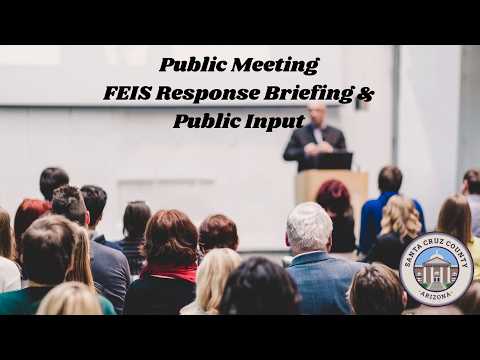
Santa Cruz County officials asked residents for input on the county's draft response to the federal Final Environmental Impact Statement (FEIS) for the mine project, and residents told county staff the draft letter does not go far enough to protect public health, water supplies and road safety.
Community Development Director Colin Bishop opened the meeting by summarizing the county's approach: the draft response is limited to whether the FEIS addressed the county's earlier draft comments and is intended to identify remaining gaps and recommend a framework for monitoring, mitigation and verification. Bishop said the letter includes a five-page executive summary and appendices that map prior comments to how the FEIS addressed them and that the county will accept additional written input before it finalizes the response.
Residents told the county that framework-level language is insufficient and urged enforceable commitments. "The FEIS response letter . . . reads more like a supportive reaction to the project than a protective regulatory comment," a resident said in a prepared statement, asserting the county's letter does not identify NEPA deficiencies, request supplemental analysis, or demand enforceable mitigation before the Forest Service issues a Record of Decision. The speaker said the letter accepts operator-run monitoring, leaving the public dependent on the mine's data, and listed omissions including water quantity and long-term aquifer drawdown, domestic-well protections and a mitigation fund, roadway and truck-safety measures, and explicit demands tied to health impacts from PM10, PM2.5 and particulate-bound metals.
Multiple commenters pushed for independent, real-time monitoring and broader data collection. Participants pointed to university-led and citizen-science programs as complementary sources of independent air and metal monitoring and urged the county to request sentinel groundwater wells and enforceable monitoring tied to public reporting. One speaker noted that some monitoring systems provide near-real-time data while other industry-run systems report elemental and metal results with delays measured in weeks; commenters said this lag impedes timely public health responses.
Several residents asked the county to examine discrepancies between draft and final permits issued by ADEQ and the FEIS numbers (for example, differing lead-emission figures and the appearance of an antimony plume in some datasets). A public commenter encouraged the county to seek accountability and to ask why permit numbers changed between draft and final versions.
Speakers also raised traffic and emergency-response concerns. The county's draft reply, commenters said, mentions only equestrian undercrossings and does not seek a third-party carrier fund or tied emergency-response resources despite projected heavy-truck traffic on local roads.
County staff responded that the recurring themes were clear and that the county wants specific language from the public to incorporate into the draft response. "This is not an endpoint," Bishop said, urging continued dialogue and coordination and noting there are still CPDA negotiations and other steps before the process concludes. Staff also indicated county leaders have consulted or are consulting with air experts and believe they have water expertise on staff, but they welcomed outside technical input and proposed wording the public might submit for inclusion.
The meeting did not include a formal vote or board action. County staff said they would collate public input, consider specific proposed language, and finalize a submitted response before the FEIS process proceeds to its next federal steps. Residents at the meeting said those next steps should include explicit, enforceable monitoring, independent verification, and conditions tied to health and water protections.
The county is accepting additional written comments and will discuss the matter again at an upcoming board meeting; a final submission timeline was not specified during the session.