Get Full Government Meeting Transcripts, Videos, & Alerts Forever!
Get email alerts on the Needs Assessment topic
No spam. Unsubscribe anytime.
Consultants report 436 survey responses; specialty care, dental and mental health top needs in Nantucket assessment
Summary
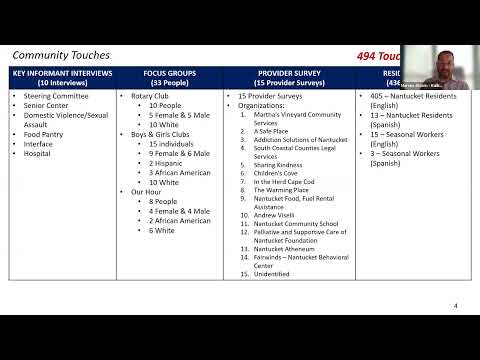
Consultants from QIC Strategic Advisors told the Council for Human Services the island needs-assessment has 436 resident survey responses (494 total community touches), with specialty medical care, dental services and mental health emerging as the top gaps; the team will return May 4–8 to collect more input from seasonal workers.
Marcos, a consultant with QIC Strategic Advisors, told the Council for Human Services on April 23 that the needs-assessment effort has collected 436 resident survey responses and a total of 494 community touches — exceeding the project sample frame of 382 by about 14%.
The QIC team will return to Nantucket May 4–8 to collect additional input from seasonal workers and other residents, Marcos said. "This is really just to give you all an update right before we come back on site the first week in May," he said. He urged the committee to help identify on‑island locations and times to reach day and seasonal workers.
Tracy Kulich, president and CEO of QIC Strategic Advisors, said the project also aims to fill a research gap: "Research about start and end of season needs, it doesn't exist," she said, noting the team has drafted abstracts and aims to circulate a draft report by Memorial Day for committee review.
Marcos summarized the respondent profile and outreach goals: roughly 96–97% of respondents report English as a primary language; about 9% reported another language (predominantly Spanish and smaller shares of Portuguese and German); 73.1% of respondents identified as women. The team noted underrepresentation of Hispanic residents (about 8–9% of respondents compared with an estimated 16% in the broader population) and said they will target outreach to increase participation among Hispanic residents and people aged 18–50.
On ranked needs, the consultants said specialty medical care moved to the top of residents' priorities after the expanded sample. Barriers identified for specialty care included limited on‑island provider availability, difficulty securing appointments and transportation off‑island for care. Dental access, affordability and insurance acceptance also ranked high as gaps. Marcos said the consultants will provide heat maps and cross‑tabs by age and population group when they distribute the slide deck.
Committee members suggested targeted outreach locations — Friday and Saturday market distributions, grocery stores such as Pip & Anchor and Bartlett's Farm, the steamship/highline arrival points (especially early boats), the hospital pharmacy, churches with Spanish‑language services, the food pantry and employer or town events — and urged careful messaging for town meeting. Sarah Wright cautioned that some residents may question outreach to non‑taxpaying seasonal workers; members recommended framing the work as community‑wide needs assessment for anyone who spends significant time on the island.
The consultants said they will produce the full report and an academic abstract; the draft report and materials will be circulated to the committee after the May on‑site work. The committee plans to review and use the data to inform grant priorities and outreach strategies.