Get Full Government Meeting Transcripts, Videos, & Alerts Forever!
Get email alerts on the Park Enforcement topic
No spam. Unsubscribe anytime.
Deputy director: better supervision and more ranger staffing part of explanation for spike in park citations
Summary
Deputy Director Jared Rogers told the Parks Board that redesigned code-of-conduct visuals show rising trespass notices and citations; staff said increased ranger staffing and supervision, plus clearer citation practices, account for some of the uptick while board members pushed for better cross-agency data and summer outreach planning.
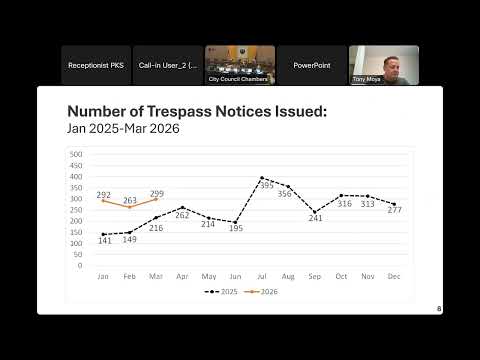
Deputy Director Jared Rogers presented a redesigned quarterly code-of-conduct report to the City of Phoenix Parks and Recreation Board, showing monthly trend lines for 2025 and the first three months of 2026 and a new breakdown of the top violation types that lead to trespass notices and citations.
Rogers said the new charts — now displayed by month rather than by week — make trends easier to see and highlighted that the top five violations producing trespasses were loitering after closure, drugs or drug paraphernalia, prohibited devices, unlawful conduct (a residual electronic‑log category), and alcohol‑related incidents. He described the vertical scale on one graph as logarithmic to preserve visibility across wide ranges.
“Educational contacts are our first tool, but you can also see where citations and trespasses cluster,” Deputy Director Jared Rogers said while describing the changes to Attachment A and Attachment D of the report.
Board members pressed staff about a sharp rise in Arizona traffic ticket and complaint (ATC) counts in early 2026. Board member Rick Neymar said January’s ATC numbers looked “huge” compared with January of the prior year; Rogers replied that part of the increase is the result of more park rangers, new supervisors and better supervision, which has improved citation reporting. “We also have newer supervisors … making sure that our staff know how to write citations when appropriate,” Rogers said, adding that some of the apparent spike reflects a steady increase in late‑2025 that carries into the new year.
Members pressed on operational follow‑ups: Board member Vieira asked what the department is doing to prepare for the expected summer surge in park use; Rogers said staff coordinate weekly with the Office of Homeless Solutions and plan outreach efforts tied to summer heat. Board member Fino asked whether the department can track 24/7 phone reports and whether those calls result in citations; Rogers said the current system does not capture that reliably and the department is analyzing a possible request for proposals to procure better call‑tracking functionality.
The board also asked about the log category labeled “unlawful conduct.” Rogers explained it exists because the electronic citation system requires a code assignment and some newer city ordinances are not yet reflected in the code‑of‑conduct taxonomy; the department plans to refine coding so this catch‑all appears less often.
Several members asked for additional cross‑agency data, specifically how often ranger interactions result in police involvement or court outcomes. Rogers said the department does not currently link citation outcomes to court records but is open to coordinating with the police department and courts to collect that information.
The board did not take any formal action at the meeting. Rogers said the department will continue to refine the report format and welcomed feedback from board members on presentation and next steps.
The board’s discussion concluded with requests for (1) clearer coding of violations to avoid catch‑alls, (2) a plan for summer outreach and staffing that ties to peak months, and (3) exploration of vendor tools to track incoming public reports and police referrals so the department can report outcomes tied to citations and trespasses.