Get Full Government Meeting Transcripts, Videos, & Alerts Forever!
Get email alerts on the Municipal Budget topic
No spam. Unsubscribe anytime.
San Gabriel council reviews proposed FY2026–27 budget, staff projects $635,000 general‑fund shortfall
Summary
City staff presented a $92.6 million all‑funds FY2026–27 proposal and a $9.4 million CIP; finance staff projected a $635,000 general‑fund deficit and recommended using reserves while pursuing efficiency and possible new revenues.
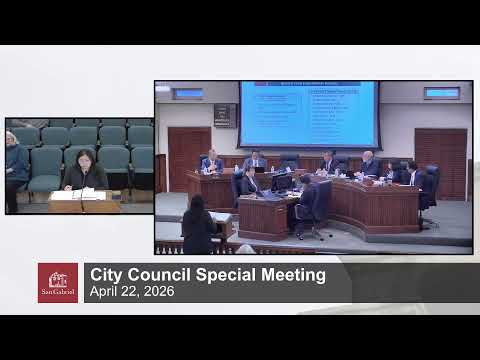
San Gabriel Mayor Chan on Wednesday presided over a study session in which Finance Director Kahula presented the city manager’s proposed FY 2026–27 operating budget and a $9.4 million capital improvement program.
Kahula told the council the city’s all‑funds budget totals $92.6 million and that the general fund — the city’s main operating fund — accounts for roughly 65% of that total. For 2026–27 staff project general fund revenues and transfers in of $59.3 million and expenditures and transfers out of $59.9 million, producing a projected net decrease in fund balance of $635,000. "We will need to use that portion of general fund reserves to maintain a structural balance budget," Kahula said.
The presentation said taxes (including property taxes and the property tax in lieu of vehicle license fee), license and permit revenues and fees account for the bulk of general fund resources. Kahula cited a 7% tax increase overall and highlighted building‑permit activity as the largest driver of a $1.1–$1.2 million increase in licenses and permits. The finance slides show operating expenditures of $87.1 million and capital projects of $5.5 million across all funds.
On the expenditure side, Kahula told the council personnel costs are the primary driver of the $3.1 million increase in general fund spending. "Full‑time salaries is driving the increase of 2.5 million," Kahula said, adding negotiated memorandum‑of‑understanding increases from the prior year and new cost assumptions are included.
City Manager Mark and staff described options the council can use to manage the projected shortfall, including vacancy freezes, targeted expenditure reductions and reserves drawdown. Mark also explained staff’s recommendation to forego a $250,000 optional contribution to the OPEB (other post‑employment benefits) trust this year because of the near‑term deficit, noting the payment is discretionary and reduces available reserves.
Council members pressed staff on several operational issues tied to budget priorities. Councilwoman Makara raised neighborhood concerns about tree roots lifting sidewalks and the coordination between public works and code enforcement; Mark and public works staff said the city maintains inventories for street segments, sidewalks and trees and that a more robust customer‑service/asset management app is planned to improve resident reporting and asset tracking. Michael, a public‑works manager, said the city inspects sidewalks on a biennial cycle and that tree work is scheduled on a four‑ to five‑year rotation, but that volume limits the department’s ability to address every site immediately.
Budget survey results that staff presented showed 129 responses collected Mar. 2–Apr. 17, with public safety/emergency response identified as the top funding priority (29%) and streets/sidewalks/infrastructure second (25%). Kahula summarized that the survey results "validate the direction of this proposed budget, prioritizing our core services such as public safety, streets, and infrastructure."
On capital projects, Linda, who led the CIP presentation, described proposed new funding of about $9.4 million for FY 2026–27: approximately $3.67 million for the annual street program (about 16 street segments and two alleys), roughly $4.4 million across Valley Boulevard intersection and related projects currently in final design, $966,000 for parks improvements, $50,000 for a storm‑drain master plan, $116,000 for veterans memorial construction documents, and $250,000 added to the Vincent Lugo access/bridge replacement project.
The proposed budget includes a recurring transfer to support the Mission Playhouse; staff show an $843,000 general‑fund transfer for the playhouse in the 2026–27 budget and forecast the transfer rising over time. Council members discussed forming a nonprofit or foundation to reduce annual transfers, noting that outside grants or a foundation could alleviate general‑fund pressure on an ongoing basis.
Council members asked detailed revenue questions. Council member Woo requested clarification between secured/unsecured property tax, property tax in lieu of vehicle license fees (VLF), and supplemental property taxes; Kahula explained the revenue classifications and how assessed valuation increases from new development are added to tax rolls progressively as projects are built.
On process, staff outlined next steps: individual briefings with council members; a community budget meeting on May 14 at Plaza Market Hall; a June 2 public hearing with possible adoption; a fallback meeting on June 16 if adoption is delayed; and a July 1, 2026 start date for the fiscal year.
No formal votes were taken at the study session. The council adjourned at 7:35 p.m.
What happens next: staff will hold one‑on‑one budget briefings with councilors, host the May 14 community meeting, and return the budget for public hearing and potential adoption on June 2.