Get Full Government Meeting Transcripts, Videos, & Alerts Forever!
Get email alerts on the Utilities topic
No spam. Unsubscribe anytime.
Port Orchard staff push to expand utility low-income discount and change leak credit
Summary
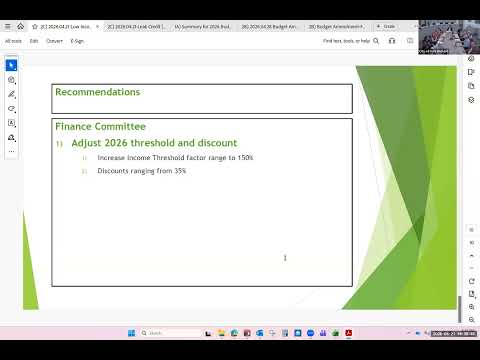
City staff and the finance committee proposed widening eligibility for the water low-income discount to 150% of the federal poverty threshold and raising the discount (current 25%) to roughly 35%; council also discussed replacing the $100 flat leak credit with a percentage-based credit (examples included 75%) and a six-month follow-up if enacted.
Port Orchard officials on April 21 reviewed two utility-policy changes aimed at lowering bills for vulnerable households.
Noah, who presented the utility-item packet, explained the existing low-income water discount applies to residential accounts with household income at or below 125% of the U.S. Census poverty threshold and provides a 25% reduction applied to base rates. Staff said the program, launched in 2023, had 24 enrolled accounts and yields roughly $420 in annual savings per enrolled household; the current annual cost to the city was estimated at about $10,500 based on that participation level.
The finance committee recommended two changes to expand access: raising the eligibility threshold from 125% to 150% of the Census poverty thresholds, and increasing the base-rate discount from 25% to 35%. Noah said those changes would broaden the pool of eligible households and, together with improved outreach, could increase enrollment. He told council staff is mailing existing participants and is prepared to accept new applications; he said a resolution would be brought back next week if council supports the direction.
Councilors asked about the fiscal impact and outreach. Staff said the immediate fiscal effect is modest at current enrollment levels but that a meaningful expansion in participation would increase the city’s annual subsidy; staff estimated the city’s cost would rise if enrollment increased, and councilors urged a six-month review after enactment to measure uptake and fiscal effect.
On a related utility item, staff reviewed the city’s leak-credit policy, a 1987-era rule that currently caps leak relief at a flat $100 credit. Staff proposed replacing the $100 flat cap with a percentage credit on the volume or billed leakage (options discussed included 50% and 75% credits). Using staff examples, a $500 leak under a 75% credit would reduce a customer’s additional charge to about $125; in extreme cases (staff gave a hypothetical $23,000 water-only charge for a very large leak), a 75% credit would still leave the customer owing multiple thousands of dollars.
Council discussion focused on detection, caps, and fairness. Several councilors said improved automatic meter-reading equipment should reduce the frequency and magnitude of unobserved leaks by identifying continuous flows more quickly. Others cautioned against open-ended liability and asked for a cap or administrative review for very large bills. Staff emphasized that credits would be contingent on documented repair and that leak-credit payout is applied only after the household has repaired and documented the fix.
Next steps: staff said it would return a formal resolution or ordinance reflecting finance-committee recommendations on the low-income discount and the proposed leak-credit change; council members signaled general support for a follow-up review period (six months).