Get Full Government Meeting Transcripts, Videos, & Alerts Forever!
Get email alerts on the Biennial Report topic
No spam. Unsubscribe anytime.
Partnership Council delays vote on biennial juvenile-justice recommendations to incorporate new research
Summary
The executive committee of the Washington State Partnership Council on Juvenile Justice agreed to delay a vote on its draft biennial report to the governor so staff can rework recommendations to reflect new data from the Washington State Center for Court Research and recent Sentencing Guidelines Commission proposals.
The executive committee of the Washington State Partnership Council on Juvenile Justice reviewed draft recommendations for the council's biennial report and decided not to vote on the final text at the meeting, asking staff for one more round of drafting to incorporate newly released research and outstanding membership changes.
Jenny, an OJJ staff facilitator, told the committee that several external reports and plans — including forthcoming work from the Washington State Center for Court Research and recommendations from the Sentencing Guidelines Commission — should be incorporated into the council's final submission to the governor. "OJJ will take on these recommendations and try to build them out a bit and provide them to the executive committee in May for review," she said.
Why it matters: The draft bundles several substantive policy proposals that could shape juvenile justice practice and state funding requests, including limits on large institutional facilities, expanded use of sentencing alternatives, a statewide emphasis on diversion, and prevention strategies aligned with the Washington Thriving Strategic Plan.
What the draft contains
- Facilities: The draft recommends eliminating or reducing reliance on large institutional juvenile facilities and updating objectives to reflect capital-budget directions for smaller, trauma-informed sites. Staff noted the draft was adjusted to match capital-budget language that references facilities of "less than 50 beds" rather than the council's prior 20–30 bed target.
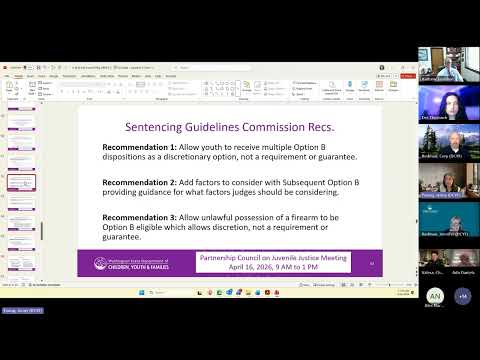
- Sentencing alternatives: The Sentencing Guidelines Commission recently developed a set of proposals the council may incorporate, including allowing youth to receive multiple "option B" dispositions (discretionary judicial decisions), adding judicial factors for subsequent option Bs, making unlawful firearm possession eligible for option B (discretionary), allowing assault second-degree to be option B-eligible for youth age 14 and older, and clarifying statutory references to class/category in option-B eligibility. The commission expects a formal report before the next legislative session.
- Diversion: The council reaffirmed Recommendation 3 — establishing diversion as the primary response for most juvenile referrals — and flagged recent 2025 law changes that removed diversion from juvenile criminal histories and directed improved statewide data collection.
- Prevention and schools: Recommendation 4 aims to dismantle the school-to-prison pipeline and strengthen cradle-to-career prevention, and staff proposed crosswalking the council's objectives with the Washington Thriving Strategic Plan to show alignment on perinatal supports, K–12 behavioral-health initiatives and student-assistance professionals.
Council reactions and next steps
Representative Lovick cautioned against declaring a rapid shift away from large institutional facilities before the community infrastructure and investments are in place. "I just feel that this recommendation may be a bit premature and may set up expectations that as a legislative body, we simply can't realize," Rep. Lovick said.
Committee members asked OJJ to draft revised language that references the Sentencing Guidelines Commission recommendations and the Washington State Center for Court Research findings. Staff will provide a first revised draft to the executive committee in May, circulate a broader draft in June for written feedback, and the full council expects to vote on the final recommendations at its July meeting.
The meeting produced no formal votes on the recommendations; instead, the committee directed staff to prepare revised wording that explicitly cites recent research and statutory updates.