Get Full Government Meeting Transcripts, Videos, & Alerts Forever!
Get email alerts on the Business License Tax topic
No spam. Unsubscribe anytime.
Manhattan Beach presents four business-license tax models to business community ahead of council briefing
Summary
City staff and consultant HDL presented a business license tax modernization study with four models—removing the cap, a single gross‑receipts rate, a raised cap, and category rates—and solicited business feedback before a May 12 council briefing and possible ballot measure this fall.
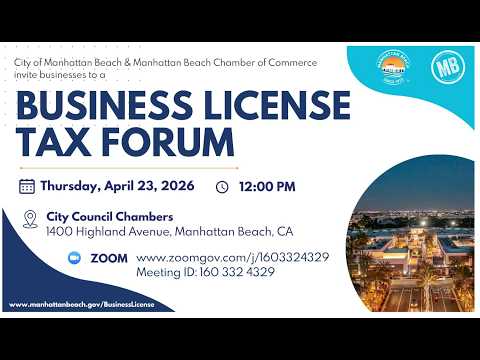
City of Manhattan Beach finance staff and a consultant team laid out four alternative ways to modernize the city’s business license tax at a public forum and asked businesses to weigh in before the proposals go to City Council.
Libby Bret, the city’s finance director, opened the session and said the code has not had a comprehensive review in roughly 50 years. Emmy Rose Hannah, the city’s financial services manager, described phase two of the modernization effort as the part that would change tax structure and therefore require voter approval. “Phase two priorities…trigger voter approval,” she told attendees.
Consultant Eric Meyers of HDL summarized the study’s findings and four illustrative models. He said the city’s current business-license cap is about $12,156 for the current licensing year and that the cap compresses liabilities: the top 100 reporting businesses account for roughly 85% of reported gross receipts but only about 35–36% of tax revenue under the current cap. Meyers described the alternatives as:
• Model 1: Remove the cap while keeping the current multi‑rate structure. HDL estimated applying that change to last year’s filings would yield roughly $2.9 million in additional revenue.
• Model 2: Move to a single gross‑receipts rate (example used: $2.80 per $1,000 after a $100 flat amount covering the first $100,000), remove the cap and lower the flat fee; HDL estimated about $2.3 million additional revenue.
• Model 3: Adopt a single gross‑receipts approach with a higher cap (example cap used in the study: $100,000); HDL estimated about $1.1–$1.2 million additional revenue.
• Model 4: Use simplified category‑based gross‑receipts rates (five broad categories: contractors, general retail, professional, property rental and services), a reduced flat fee and a $100,000 cap; HDL estimated roughly $0.5 million additional revenue. Meyers called gross receipts “the gold standard” for a future‑proof local business tax because it ties tax to taxable activity rather than inputs such as employment.
City staff repeatedly framed the study as an effort to modernize and simplify code language, not solely as a revenue-raising exercise. “We started on this path to update our code that’s so outdated,” Emmy Rose Hannah said. The presentation noted the city currently receives about 5% of general‑fund revenue from the business license tax.
The forum included multiple real‑world examples HD L used to illustrate impacts on subcontractors, restaurants, medical offices and commercial property. The consultant highlighted that models 2–4 would, as presented in the study, eliminate the current commercial‑property sales‑tax credit, producing larger effects for landlords and some commercial owners in the study’s hypotheticals.
Staff closed the forum with one last live poll and said the city will present the study and the forum’s feedback to City Council on May 12. If community polling in May–June supports a ballot measure, staff said they would pursue placing a tax measure on the ballot in time for the November 3 general election.