Get Full Government Meeting Transcripts, Videos, & Alerts Forever!
Get email alerts on the Floodplain Management topic
No spam. Unsubscribe anytime.
Williams County adopts updated floodplain ordinance to comply with SB 2027
Summary
The commission adopted Ordinance 2026-04-21 updating floodplain management procedures and a fee schedule to comply with North Dakota Senate Bill 2027 and to avoid National Flood Insurance Program suspension; the ordinance adopts FEMA map updates and sets permit and variance fees.
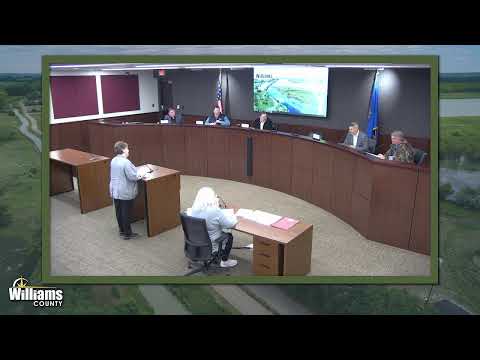
Cameron Himer of Development Services told the Williams County Board of County Commissioners on April 21 that Senate Bill 2027, enacted by the North Dakota legislature on August 1, 2025, requires communities to update floodplain management ordinances and to annually certify compliance to the Department of Water Resources. Failure to update could lead to suspension from the National Flood Insurance Program (NFIP).
County staff and attorney Karen Proud drafted a proposed Williams County floodplain management ordinance based on a model from the Department of Water Resources. The ordinance covers development permits, variances, appeals, compliance, violations and enforcement. Himer said only two Special Flood Hazard Areas identified by FEMA exist within Williams County (portions of Buford and Trenton townships) and that floodplain applications have been rare in county practice.
The proposed fee schedule was presented: a floodplain development permit fee of $200, an administrative variance fee of $100, and a floodplain variance fee of $200 to cover staff advertisement and processing work. The proposed ordinance also automatically adopts any FEMA flood map and flood insurance study updates made available to the public.
A commissioner moved to approve Williams County Ordinance 2026-04-21 (Williams County floodplain management ordinance) and the accompanying fee schedule, and to authorize the chairman to sign. The motion was seconded and passed unanimously by roll call.
The county will file and certify updates as required by state law and coordinate with the Department of Water Resources to maintain NFIP eligibility.