Get Full Government Meeting Transcripts, Videos, & Alerts Forever!
Get email alerts on the Utility Permitting topic
No spam. Unsubscribe anytime.
Cole County staff propose updated utility permitting rules and new fees as broadband work surges
Summary
Public works staff told the Cole County Commission that permit requests have jumped this year and presented a draft update to 1995 permitting rules that would add fees, minimum restoration standards and weekly charges for long-running projects to help the county recover inspection and pavement-repair costs.
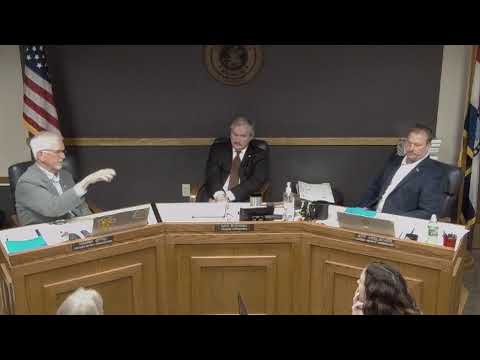
Public works staff briefed the Cole County Commission on proposed updates to the countys utility permitting policies, saying decades-old rules and low fees leave the county struggling to inspect and restore rights-of-way amid a surge of broadband and other utility work.
"Were getting 40 since the first of the year," the public works official said, describing a sharp rise in permit requests and the operational strain on existing staff. The official said the current rules date to 12/07/1995 and the department stopped consistently charging for permits years ago, leaving inspections underfunded.
The draft posted by staff highlights two permit categories: a basic permit (staff cited a $60 fee in the draft) and a "complex" permit used for large, multiweek installs. For complex jobs, staff proposed a weekly monitoring charge ($370 per week in the draft) intended to reflect the staff time needed to oversee long-running projects. The presentation also described a pavement-preservation fee tied to road age and restoration methods; staff cited a sample restoration-related figure of $309,100 while explaining how cut-and-replace requirements would be enforced.
The draft would also tighten operational requirements, including limits on working hours (generally 7 a.m. to 6 p.m.), prohibitions on leaving equipment parked in travel lanes without proper traffic control, standards for trench depth, and requirements that disturbed areas receive six inches of topsoil and appropriate surface restoration.
Staff said some utility companies coordinate well but contractor practices are inconsistent, and local inspectors cannot reliably monitor every site without additional resources. "Were not at the point of hiring a full-time inspector," the public works official said. "It might be a part-time person." That staffing discussion underpins the proposed fee increases, staff said, because updated fees would allow the county to recover administrative and inspection costs.
Commissioners and staff discussed how the draft relates to pending state legislation. The public works official said a recent legislative draft would have required counties to pay relocation costs for non-rate-regulated utilities but that the language had been modified to remove cities and counties; staff said having clear, updated county regulations would help if the Legislature revisits the issue.
Several commissioners asked about who would be affected. Staff said the rules apply broadly to any work in county right-of-way but that minor homeowner activities (for example, routine mailbox or landscaping work covered by building permits) are not intended to be captured by the new permit requirements. The official said emergency repairs by essential utilities (electric, water, sanitary sewer) can proceed and be permitted retroactively to ensure critical services are not delayed.
Staff told commissioners they will return with a cleaned-up draft for formal review and potential adoption, and they recommended outreach to contractors and the city utility coordination meetings to notify affected parties. "If youve got comments or suggestions, wed be happy to hear that," the public works official said. The commission asked staff to confirm any public-notice or statutory hearing requirements before formal adoption.