Get Full Government Meeting Transcripts, Videos, & Alerts Forever!
Get email alerts on the Community Violence Intervention topic
No spam. Unsubscribe anytime.
Expert briefing urges Seattle to unite and professionalize community violence intervention efforts
Summary
Presenter Devitta Briscoe told the Public Safety Committee Seattle has strong CVI programs but lacks city'level governance, data integration and workforce professionalization; she recommended an office of violence prevention, data dashboards and phased pilots.
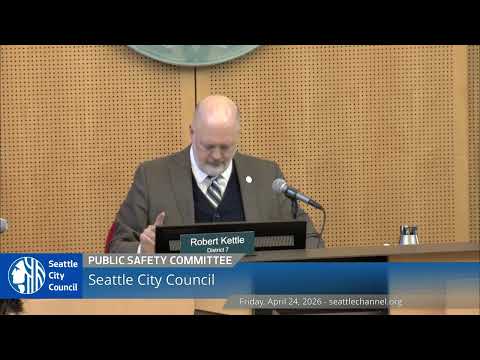
Devitta Briscoe, who said she previously served as a gun'violence prevention liaison, briefed the Public Safety Committee on April 24 about opportunities to strengthen Seattle's community violence intervention (CVI) ecosystem.
Briscoe defined CVI as a public'health'oriented, targeted set of strategies that interrupts cycles of retaliation by focusing on small groups and neighborhoods at highest risk. "Because it's so concentrated that means it's also the most preventable form of violence," Briscoe told the committee, arguing that CVI is "complementary to police" in preventing violence rather than a replacement for investigations or removal of guns from the street.
She identified four principal gaps in Seattle: lack of a unified governance structure, fragmented funding and data siloes, inconsistent oversight and lack of standardized training and operating procedures for CVI workers. Briscoe recommended a city'led governance framework (an Office of Violence Prevention or similar), integrated data dashboards to measure dosage and outcomes, and workforce professionalization with standard operating procedures and recurring training so community interrupters are treated as first responders.
Briscoe pointed to national examples, including New York City's neighborhood'level presence, and said successful programs commonly follow a phased path: assessment of local CVI capacity, creation of governance and an office, pilots with data'driven targets, evaluation and scaling of what works. She told the committee that federal, state and local funding exists but often must be aligned rather than fragmented.
In response, Councilmember Lin stressed the urgency of youth gun'violence in his district and the importance of building trust between community partners and SPD. Vice Chair Saka and Chair Kettle urged executive'level ownership and faster execution, referencing existing ordinances and an auditor'recommended data agenda. The committee did not adopt immediate legislation but flagged follow'up work and budget development as next steps.
Briscoe concluded that an ecosystem approach with governance, data and professionalized capacity could help sustain violence reductions and better coordinate city, county and community partners.