Get Full Government Meeting Transcripts, Videos, & Alerts Forever!
Get email alerts on the Emergency Preparedness Food Security topic
No spam. Unsubscribe anytime.
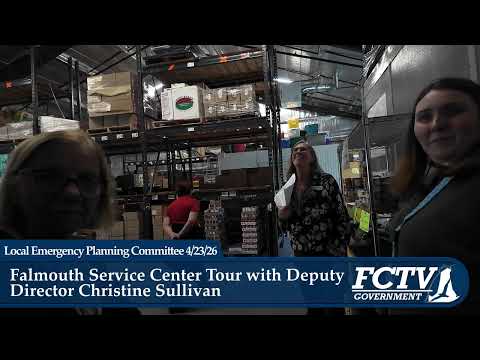
Falmouth service center shows partners how pantry runs, warns storm exposed communication gaps
Summary
Town of Falmouth service-center staff gave a tour of pantry operations and emergency plans on April 23, saying the pantry distributed more than a million pounds of food in 2025 and now serves about 550 households weekly, and urging better communications planning after the recent snowstorm disrupted internet and phone service.
Christine Sullivan, deputy director of the Town of Falmouth service center, led housing, Red Cross and other partners on a site tour and emergency-preparedness briefing on April 23, focusing on how the pantry operates, where its food comes from and how partners might coordinate more effectively during future storms.
The visit came after a snowstorm this spring that left internet and many voice-over-IP phone lines down, forcing staff to switch to prepacked bags and drive-through distribution. "We weigh all the food coming in the door and all the food going out the door," Sullivan said during the tour, noting that "2025 was over a million pounds of food" distributed through the pantry and related outreach.
Why it matters: the pantry and its partners provide critical food and material assistance to vulnerable residents, and organizers said strained communications and faster inventory turnover leave less buffer ahead of extreme-weather events. Karen Delaney, the service center's executive director, said the pandemic-era shift in volume means the pantry now moves food much more quickly: "We now serve about 550 households a week," she said, up from roughly 200 in earlier years.
How the pantry works: staff described a client-choice model where shoppers fill a "menu" and volunteers pick items; orders are given a number at check-in and weighed at exit to maintain inventory data. Volunteers also support a weekly "senior shopping" session and a community closet of free clothing and housewares that was moved indoors last September after space had been limited. Brian Dugan, the warehouse manager, said much of the hygiene and supply stock is donated: "That's all been donated," he said, describing shelves of personal-care items and rotating stock.
Sources and capacity: organizers said about 60% of the pantry's food comes from the Greater Boston Food Bank — currently cited as roughly 12,000 pounds weekly — with the pantry purchasing much of the remaining supply. Christine Sullivan said pre-COVID weekly receipts were closer to 18,000 pounds and that faster demand now reduces the amount of buffer inventory available before storms. She also highlighted local partners: "Farming Falmouth provided 7,900 pounds of produce to us last year," Sullivan said, and the pantry uses two freezers and dedicated produce and dairy coolers to handle perishables.
What went wrong in the storm: speakers described multiple, linked communication failures. Internet-dependent landlines and some cell coverage went down; one participant explained that Verizon's local wiring and generator hub create single points of failure for some services. In the immediate response, partners relied on door-to-door wellness checks, maintenance crews to plow and clear access where possible, and on-site generators at some emergency facilities. Sullivan recounted that during the outage the pantry operated with "bare minimum" inventory and used a drive-through model and prepacked bags until normal operations could resume.
Outreach and preparedness steps agreed: Red Cross representatives offered multilingual educational workshops and materials tailored to elders and other audiences, and proposed distributing preparedness brochures in grocery orders. A Red Cross representative said the organization can provide workshops and materials in Portuguese, Spanish and Haitian Creole on request. Partners also discussed leveraging the town's official alert system (falmouthma.gov sign-ups) and keeping battery- or crank-powered radios tuned to local station 99.9 QRC as an offline fallback when internet and cellular access fail.
Concrete details organizers emphasized: weekly food receipts of about 12,000 pounds from the food bank, serving roughly 550 households a week, the pantry's largest single packed order (reported as 95 pounds), and local produce donations of about 7,900 pounds from Farming Falmouth last year. Staff also flagged the timing challenge that food deliveries typically arrive on Tuesday and heavy turnover can leave the warehouse near empty before a storm.
Next steps and follow-up: partners agreed to explore putting Red Cross brochures and brief preparedness lists into groceries distributed by the pantry, to consider raffling preparedness backpacks to raise awareness, and to keep talking with the food bank's network of large distributors about prepositioning supplies for major events. The meeting closed with organizers thanking attendees and noting a volunteer appreciation dinner later the same day.
The service center and partners said they will continue coordination to reduce communications gaps and better preposition supplies before the next significant storm.