Get Full Government Meeting Transcripts, Videos, & Alerts Forever!
Get email alerts on the Criminal Justice Double Jeopardy topic
No spam. Unsubscribe anytime.
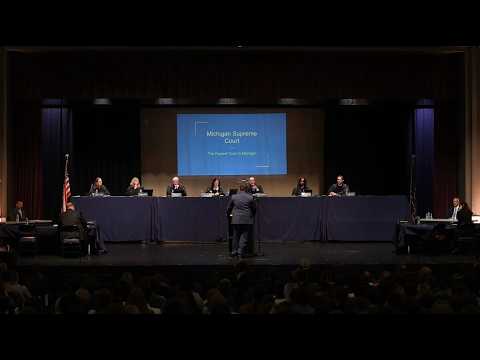
Michigan Supreme Court hears argument in People v. Jennings over double‑jeopardy standard
Summary
In oral argument in People of the State of Michigan v. Jennings, the Michigan Supreme Court considered whether the state constitution requires a more protective double‑jeopardy test than the U.S. Supreme Court's Oregon v. Kennedy standard, with defense counsel urging a bad‑faith/overreaching test and the prosecutor and an amicus disputing the need or workability of such a change.
The Michigan Supreme Court heard argument in People of the State of Michigan v. Jennings, No. 165764, over whether the state constitution affords broader protection against retrial after a mistrial than the U.S. Supreme Court's Oregon v. Kennedy rule.
Jason Edgar of the State Appellate Defender Office, representing Mr. Jennings, told the justices that Michigan courts should reject Kennedy's subjective-intent standard and instead apply a bad‑faith or overreaching test rooted in state tradition. "State courts and constitutions play a vital role in protecting and defining individual rights," Edgar said, arguing that Kennedy "frustrates [double‑jeopardy's] purpose by limiting the application of the right to circumstances where the prosecutor subjectively intended to provoke mistrial." He urged the court to reaffirm earlier state cases that applied a bad‑faith standard and to give lower courts guidance about what constitutes overreaching.
The prosecutor arguing for the People, introduced to the court on behalf of the People, countered that a bad‑faith test would be imprecise and unworkable. He told the justices that the line of precedent reaching back to mid‑20th century cases has always focused on prosecutorial intent and that Kennedy supplies a clear, administrable rule: a defendant must show the prosecutor intended to provoke the mistrial. "Bad faith is ill‑defined," he said, arguing that Kennedy helps avoid disparate outcomes and provides a workable analytic framework for trial and appellate courts.
Miriam Mockerman of the ACLU of Michigan, appearing as amicus curiae, urged the justices to abandon the "compelling reason" formulation that sometimes conditions independent state‑constitutional analysis on a showing of a compelling reason to depart from federal interpretation. Mockerman said the test has created confusion in lower courts and that Michigan should reaffirm its historic practice of independent constitutional interpretation.
Throughout argument, several justices pressed both sides on practical consequences: whether adopting a more protective state standard would require overruling or narrowing prior state precedent (including Dawson and decisions invoking the "compelling reason" inquiry), how trial courts should assess intent and overreaching on the record, and whether findings by trial judges (for example that intent to provoke a mistrial was not shown) should be reviewed for clear error. Defense counsel responded that objective facts can inform subjective intent and that courts in other jurisdictions have applied broader standards without unmanageable difficulty; the prosecutor warned that a shift could yield uneven results, such as different remedies depending on whether prosecutorial misconduct was raised pre‑ or post‑verdict.
Neither side asked for immediate emergency relief; after extended questioning and brief final remarks from counsel, the court took the case under submission.
The court's decision will determine whether Michigan adopts a more protective test for when double‑jeopardy bars retrial after prosecutorial misconduct and whether the "compelling reason" rubric will continue to shape state constitutional analysis.