Get Full Government Meeting Transcripts, Videos, & Alerts Forever!
Get email alerts on the Pests And Invasive Species topic
No spam. Unsubscribe anytime.
State entomologists report new emerald ash borer finds, urge keeping wood local to slow spread
Summary
Maine Forest Service entomologists described new emerald ash borer (EAB) detections, showed an interactive dashboard of quarantine extents, and urged municipalities and landowners to keep removed ash material local and follow quarantine guidance.
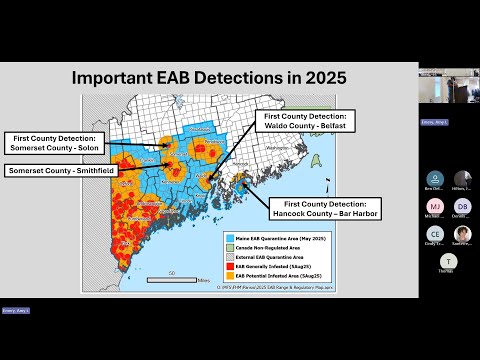
Mike Pericchio, a forest entomologist with the Maine Forest Service, told a Belfast audience that the state’s annual monitoring program found several new emerald ash borer (EAB) detections this year and that public reports continue to be a major source of information. "Belfast is a town within the quarantine zone," he said, and the state is running roughly 201 purple prism traps this season after 182 the previous year.
Pericchio described two layers used on the state map: a 3‑mile confirmed buffer around each verified find and a 10‑mile zone in which communities should begin planning and responding. He said each new county detection prompts sample submission to the U.S. Department of Agriculture for verification and typically triggers a press release and quarantine revision. "Every time there's an expansion in quarantine, there's always a press release associated with it," he said.
The entomologist described monitoring tools: purple prism traps for broad surveillance and girdled trap trees—intentionally wounded ash trees that attract beetles—for finer detection. He said the girdle program detected positives in Northern Maine this year and that state crews process girdled trees in late fall and winter to look for larvae.
On regulation and movement controls, Pericchio said formal agreements allow ash logs to move to mills if the receiving facility has a written agreement to destroy waste material and follow stipulations (often moving material in dormant months). He advised landowners and contractors to minimize transport distances for removed ash and to prefer chipping and local disposal when possible. "Chips used to be a regulated item, when EAB was federally regulated. But years of observation shows EAB does not survive in open chips," he said, noting that chips are no longer regulated in Maine.
Pericchio and colleagues emphasized practical next steps for communities: sign up for the EAB mailing list, use the state dashboard (maine.gov/eab) to check local status, and plan inventories and treatment or removal strategies with licensed arborists. The state will continue end‑of‑season processing of traps and girdled trees before finalizing quarantine boundaries for the year.
What happens next: the Maine Forest Service will finish seasonal surveys, peel and inspect girdled trees this winter, and update quarantine maps and public notices accordingly.