Get Full Government Meeting Transcripts, Videos, & Alerts Forever!
Get email alerts on the Public Works topic
No spam. Unsubscribe anytime.
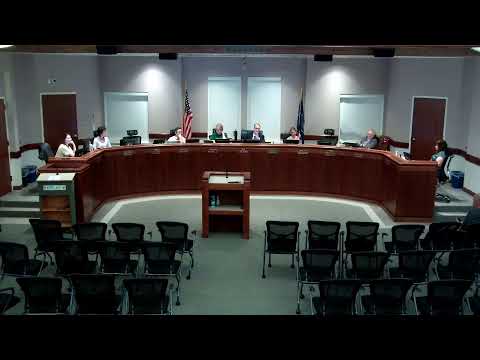
Centerville council narrowly approves limited process for sidewalk-deferral requests after heated debate
Summary
After a lengthy public hearing and debate over safety and equity, Centerville’s council approved Ordinance 2026-13 allowing the council to consider limited deferral agreements for required public improvements in constrained neighborhoods, amending staff language to limit the distance threshold and asking staff to prepare an historic-district sidewalk map.
Centerville’s City Council on April 21 adopted a contentious amendment to the municipal code that lets property owners in narrowly defined circumstances ask the council to defer required public improvements — primarily sidewalks — when topography or preexisting conditions make construction impractical.
The amendment grew out of an application by neighborhood resident Kyle Green, who said his block should be eligible to ask for a deferral because required sidewalks would “end at a six-foot retaining wall” or otherwise dead-end into private features. “We didn’t want sidewalks to nowhere,” Green said, describing the neighborhood’s historic layout and previous 1993 improvement decisions.
Staff (Sydney) told the council the proposal had serious tradeoffs: deferrals can leave the city exposed to higher future costs if construction prices rise; they are difficult to call back decades later; and subdivision-triggered deferrals risk being used by larger developers to avoid installing sidewalks. Staff recommended denying the applicant’s original request and instead submitted a redlined version that tightened criteria for eligibility and preserved many of the city’s protections.
Council members and residents debated safety, fairness and administrative tools for addressing sidewalk gaps. Some councillors and staff urged a citywide map or an explicit historic-district overlay that would identify where sidewalks are not required, arguing that such a map would be a cleaner long-term tool than ad hoc deferrals. Others argued that denying a modest, council-reviewed exception would force one household to shoulder an unreasonable cost.
Councilman (Banger) moved approval with an amendment reducing the distance threshold used to determine eligibility (the council accepted a compromise tied to lot frontage, expressed as three lots/180 feet in the amendment). The motion passed 3–2.
Council members who voted in favor said the change creates a narrowly tailored, discretionary process that still allows staff and council to protect safety and equitable outcomes. Dissenting members objected to the use of deferrals as the mechanism and pressed staff to return quickly with a mapped policy (historic-district overlay) rather than leave long-term decisions to case-by-case council discretion.
As part of the action, council asked staff to return with a recommended historic-district sidewalk map and suggested additional analysis on whether city-initiated rezonings or special-improvement districts (which allocate cost across multiple properties) would be more appropriate in some locations.
The ordinance change does not automatically exempt any parcel from installing required improvements; it creates a path for property owners to petition the council for a deferral subject to findings and conditions.