Get Full Government Meeting Transcripts, Videos, & Alerts Forever!
Get email alerts on the Public Health Waste Management topic
No spam. Unsubscribe anytime.
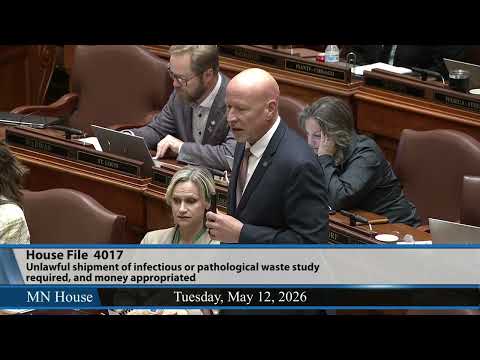
House passes study of unlawful shipments of infectious waste with $75,000 study appropriation
Summary
The Minnesota House passed House File 4017, directing the Pollution Control Agency to study unlawful shipments of infectious and pathological waste and appropriating $75,000 for that work; a technical amendment was adopted to focus responsibility on generators rather than haulers. The bill passed on a roll call, 126–8.
The Minnesota House on the floor passed House File 4017 on a roll call after adopting a technical amendment that narrows liability and focuses the forthcoming study on generators of infectious waste.
Representative W. Johnson, the bill’s author, told colleagues the measure responds to images and reports of biological material appearing in recycling and solid-waste facilities. “This bill … is a study of unlawful shipment of infectious or pathological waste,” Johnson said, describing material found on facility floors and the worker-safety and public-health risks it poses. He described the required study’s scope: the commissioner of the Minnesota Pollution Control Agency must submit an assessment by Jan. 15 of the extent and frequency of unlawful transfers to solid-waste facilities and the costs associated with those transfers.
The bill includes a $75,000 appropriation from the state’s environmental fund for the MPCA to complete the assessment. Representative Johnson said the money is intended to “get a handle on this” and to identify how the state should respond to incidents in hospitals, surgery centers and other generators.
A technical amendment (A6) clarified that haulers who unknowingly receive contaminated loads would not be the primary target of enforcement; instead, responsibility would rest with those generating the waste. Representative Fisher called the amendment “a good common-sense amendment” and urged a green vote. The amendment was adopted by voice vote.
On final third reading, the clerk called the roll and the House passed HF4017 as amended by a recorded vote of 126 yeas and 8 nays. The bill’s title was agreed to, and the measure will proceed to the next steps required for enactment.
The House’s action directs the MPCA to report back with findings and cost estimates; the bill does not itself set penalties beyond asking for assessment of potential fines and remedies. The author and supporters framed the bill as a worker-safety and public-health study to identify where unlawful transfers are occurring and how to address them.