Get Full Government Meeting Transcripts, Videos, & Alerts Forever!
Get email alerts on the Homelessness topic
No spam. Unsubscribe anytime.
Residents press Orange County for action as riverbed encampments increase; critics question CityNet contract
Summary
Multiple Fountain Valley and other Orange County residents told the Board the Santa Ana Riverbed encampments have worsened, citing theft, sanitation and safety concerns; several speakers said CityNet’s $720,000 county contract has yielded little beyond bottled water and urged more permanent, housing‑first solutions.
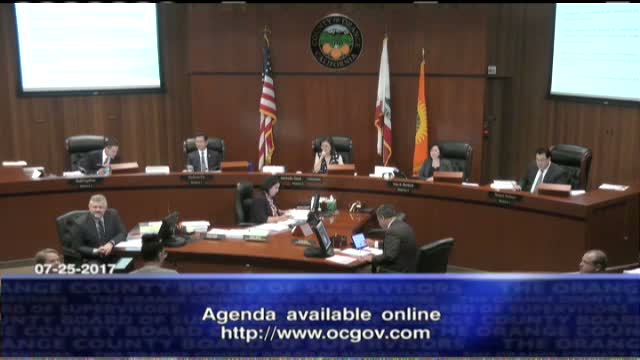
A string of public commenters at Tuesday’s Orange County Board of Supervisors meeting urged faster, clearer action on riverbed encampments and questioned whether the county’s $720,000 CityNet contract has delivered meaningful services.
"If these people are refusing services, they need to be forced to either be arrested because there's no lobbying force," said Ginny Nicole of Fountain Valley, recounting that a homeless tent was pitched outside her daughter’s bedroom window and that she was warned she could be arrested for moving it. "I was told that I would be arrested if I moved the tent," Nicole told the board.
Sarah Wallace of Santa Ana criticized how CityNet has spent county funds and said, "CityNet has done nothing but buy bottled water," a point she used to urge the board to examine CityNet’s supportive services. Several nearby residents including Carol McGee, Pamela Swartz and Jonathan Ann described a rise in thefts, trespassing and unsanitary conditions near the Santa Ana River and urged the county to coordinate enforcement and services across agencies.
Jonathan Ann said he and his neighbors were confused that CityNet’s scope is limited geographically and asked what metrics were used to decide service areas: "Was it just simply 10 count? Was it the amount of incident reports filed with the police? We don't know for sure," he said.
A number of commenters proposed alternative or interim solutions: Paul Hike suggested turning vacant lots into sanctioned sites with portable toilets and showers, and Sarah Wallace and others urged pursuing permanent supportive housing and exploring vacant state facilities or a campsite model rather than investing in fencing and boulders.
Several speakers expressed frustration at law‑enforcement coordination. Carol McGee and others said calls to police or dispatch yielded inconsistent responses and that responsibility was being passed between agencies. The sequence of comments repeatedly asked the board to provide clearer direction and to accelerate permanent housing and sanitation options.
County staff did not immediately provide a rebuttal during the public‑comment period; multiple supervisors later noted the county has a CityNet contract focused on certain areas and indicated staff would follow up.
The board received the public comments and proceeded with the agenda; no new policy was adopted during the meeting on the riverbed encampments.