Get Full Government Meeting Transcripts, Videos, & Alerts Forever!
Get email alerts on the Fire Safety And Data Transparency topic
No spam. Unsubscribe anytime.
Ann Arbor officials tell renters commission why some inspection and court data aren’t public and clarify extinguisher rules
Summary
City building and fire officials told the Ann Arbor Renters Commission that STREAM’s current consultant scope does not include inspection-report content or court case results, and explained that single-family rentals are not required to provide fire extinguishers while multi‑unit buildings must provide extinguishers in shared spaces.
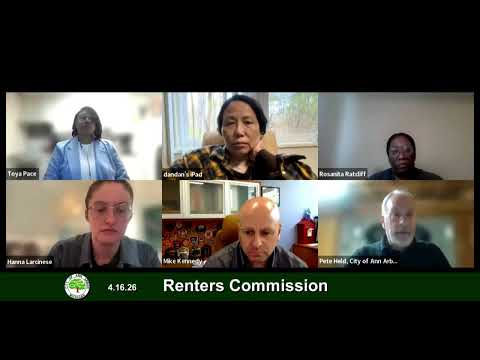
Pete Held of Ann Arbor Building Inspection & Rental Services and Fire Chief Mike Kennedy briefed the Renters Commission on April 16 about limits to the city’s public data and the fire-safety rules that affect renters.
Held said a newly approved consulting contract will evaluate internal workflows and the STREAM web interface for application submission and inspection activity “but it's not going to go into inspection reports,” and that court-case outcomes (for example, eviction decisions) are maintained by the 15th District Court and generally are not available in STREAM. He added that code-case complaint files are not public-facing and are vetted to protect residents’ privacy, though staff can provide aggregated or targeted information on ordinance effectiveness on request.
The clarification matters because renters and tenant advocates have asked for searchable records that show past enforcement actions by landlord. Held said public inspection records for permits and routine rental compliance inspections are available online, but complaint-driven code cases are handled differently to protect individual privacy.
On fire-safety rules, Chief Kennedy said single‑family homes used as rentals are not required under Ann Arbor’s Chapter 105 to have landlord-provided fire extinguishers; by contrast, multifamily buildings commonly must provide extinguishers in public areas such as shared hallways or stairwells. “We want them to get out as quick as possible,” Kennedy said, describing the department’s emphasis on evacuation over expecting untrained occupants to use extinguishers.
Kennedy and Held also described differences between fire suppression (sprinkler systems) and portable extinguishers: newer multifamily construction is typically sprinklered, which reduces the reliance on extinguishers; extinguisher placement and required frequency of inspection depend on building layout and code triggers rather than a simple unit count.
Officials recommended practical tenant steps: call 911 for carbon-monoxide alarms and evacuate, report concerns about alarm efficacy to either rental housing services or the fire department, and take advantage of public training opportunities. Kennedy noted the Police & Fire public-safety open house on May 16 (11 a.m.–1 p.m.) will include a hands-on fire-extinguisher trainer.
Staff also reviewed operational and budgetary issues: the rental-inspection program now has roughly 10 regular inspectors, allowing the city to maintain its inspection cadence, and the fire department is seeking additional staffing to address increased demand from high-rise growth — adding one 24/7 fire company would require about 12 positions and roughly $1.7 million in recurring cost, Kennedy said.
The department said it is reviewing false-alarm fee structures (the existing fee is $250) because a small number of repeat locations generate disproportionate responses and operational burden; staff described ordinance work under consideration to allow tiered or escalating penalties for chronic offenders.
Next steps: staff invited commissioners to request targeted reports or aggregated data, and said they will follow up on specific information requests and feasibility checks about publishing summarized enforcement or alarm-history metrics.