Get Full Government Meeting Transcripts, Videos, & Alerts Forever!
Get email alerts on the Civic Governance topic
No spam. Unsubscribe anytime.
Moraga council leans toward ceremonial flag policy after public praise for flying Pride flag
Summary
After public testimony urging the town to fly the Pride flag, the Moraga Town Council directed staff to draft a narrowly tailored ceremonial flag-display policy (option two) with objective standards, a likely 30-day limit for commemorative flags, and location options (town offices, council chambers or both) to return to the council for adoption.
The Moraga Town Council on April 22 heard extensive public comment and discussion about whether municipal flag poles should allow commemorative flags such as the Pride flag and directed staff to craft a narrowly drawn ceremonial flag-display policy for council consideration.
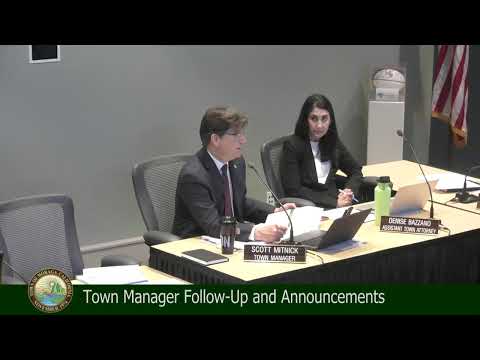
Town Manager Scott Mitnik reviewed two options: maintain the current traditional practice (U.S., state and local flags only) or adopt a governmental 'ceremonial flag display' option that includes narrowly defined rules about which flags may fly, where, for how long, and who is responsible for maintenance or donation. "If you are interested in allowing other types of flags or symbols to be displayed, you have some policy options," Mitnik said.
Residents urged action. Sherry Sweeney, a Moraga resident, told the council that flying a Pride flag is “a statement about belonging” and that a content-neutral, well-structured policy can minimize legal risk while allowing government speech. Student Chris Bragg, president of St. Mary’s College Pride organization, said seeing a Pride flag in town “would mean the world” to young people arriving in Moraga. Brie Sanchez of P Flag Moraga/Lamorinda said the council’s recent Pride Month resolution is welcome but “doesn't have the reach or power of the flag.” Wendel Baker offered to donate flags.
Council members repeatedly acknowledged legal considerations raised in the staff report and the town attorney’s guidance but expressed a preference for option two with narrow, objective criteria to preserve the government-speech posture and deny that the pole is an open public forum. Council discussion focused on practical details: limit commemorative flags to a short duration (staff noted 30 days is customary), keep the U.S. flag at the top with commemorative flags below it, and present both potential locations (town offices and the council chambers flag pole) for council decision. Several council members said they favored presenting both locations in the drafted resolution and returning to the council at the next meeting so the policy could be in place by June if approved.
The meeting produced direction but no final ordinance or resolution; staff will prepare a draft policy with objective standards, recommended duration, a process for council approval of commemorative flags, and options for location and donor/maintenance responsibilities.