Get Full Government Meeting Transcripts, Videos, & Alerts Forever!
Get email alerts on the Syria Humanitarian Response topic
No spam. Unsubscribe anytime.
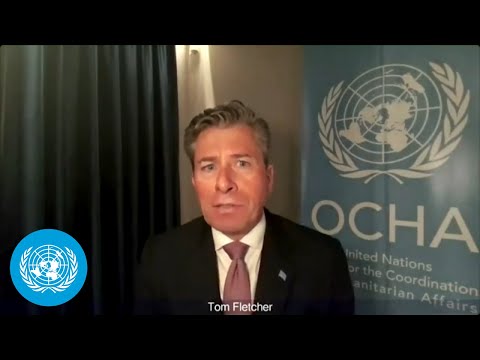
Tom Fletcher says Syria shows fragile recovery and urges $1.5 billion in immediate aid
Summary
Tom Fletcher briefed the council on cautious humanitarian gains in Syria — return movements, market and service restoration — while warning of regional spillover, mines and a severe funding shortfall; he urged sustained diplomacy, $1.5 billion in prioritized aid and longer‑term recovery investment.
Tom Fletcher told the council that Syria is showing “a more positive trajectory” after years of conflict but warned gains are fragile and at risk without urgent action. He said millions of people are returning, markets are reviving and “more lights [are] coming back on,” but he urged realism alongside hope.
Fletcher, who said he visited Syria in December 2024 and again last month with his UNDP colleague Alexander Krauss, described a recovery agenda he said builds on trust with Syrian authorities. He said the humanitarian needs and response plan was jointly launched on April 2 — the first such plan launched inside Syria and with the Syrian government — and that Damascus has extended dollarization for six months to ease liquidity and speed implementation.
“We jointly launched the humanitarian needs and response plan on April the 2nd,” Fletcher said, and he reported that in quarter one his offices dispersed $84 million from merged country and cross‑border pooled funds, with roughly two‑thirds of that going to 72 local partners. He added that “this month we’ve allocated a further $146 million of funding from the US government to 17 life‑saving projects” to start by May 1 with facilitation support from authorities.
Fletcher outlined three major risks to continued progress. First, he said regional conflict in March strained Syria’s recovery, noting that “as of April the 19th, nearly 300,000 people have crossed to Syria from Lebanon, overwhelmingly Syrian nationals,” adding to “an estimated 1.6 million Syrian refugees” who have returned since the end of 2024.
Second, he cited persistent internal needs and access gaps: “13 million need food. 12 million need clean water. Nearly 13 million need health care.” He flagged displacement in the northeast (about 100,000 people), restricted movements that limited convoys (30 trucks admitted on March 16), and electricity shortfalls that have damaged services in water, health and education.
Fletcher also described recent floods affecting more than 20,000 people and damaging roughly 3,500 shelters. He highlighted explosive‑ordnance risks: “Mines, unexploded ordnance continue to exact a horrific toll, killing more than 50 people, injuring over 100 since mid‑March alone. Nearly one in three victims a child.” He said accelerated demining is essential to allow voluntary returns and for children to resume schooling.
Third, Fletcher warned of acute funding shortfalls. He said the 2025 plan was about 42% funded, listing leading donors as the EU, the U.K., the U.S., Germany, Saudi Arabia and Qatar. He said over 400 health facilities were hit by funding shortfalls, with more than 300 suspended and more than 7 million people affected; winter support was at 28% of requirements. He added that the World Food Programme needs $200 million in six months to avoid large‑scale suspensions.
On what the council should do, Fletcher gave three requests: “First, sustain this diplomatic energy. Use your influence to resolve the remaining flash points, allow people to return safely, voluntarily, with dignity inside Syria and across the region.” Second, he asked members to “support vital humanitarian operations,” noting a full requirement of $2.9 billion but saying a hyper‑prioritized $1.5 billion over the next six months is the minimum needed to prevent a reversal of gains. Third, he urged sustained, predictable investment in recovery and development so “Syria could be that story,” but only if the council helps overcome the three risks he identified.
The presiding officer thanked Mr. Fletcher for his briefing. The briefing closed with Fletcher’s appeal that diplomatic engagement, immediate humanitarian support and long‑term investment are all needed to sustain recovery.