Get Full Government Meeting Transcripts, Videos, & Alerts Forever!
Get email alerts on the Stormwater topic
No spam. Unsubscribe anytime.
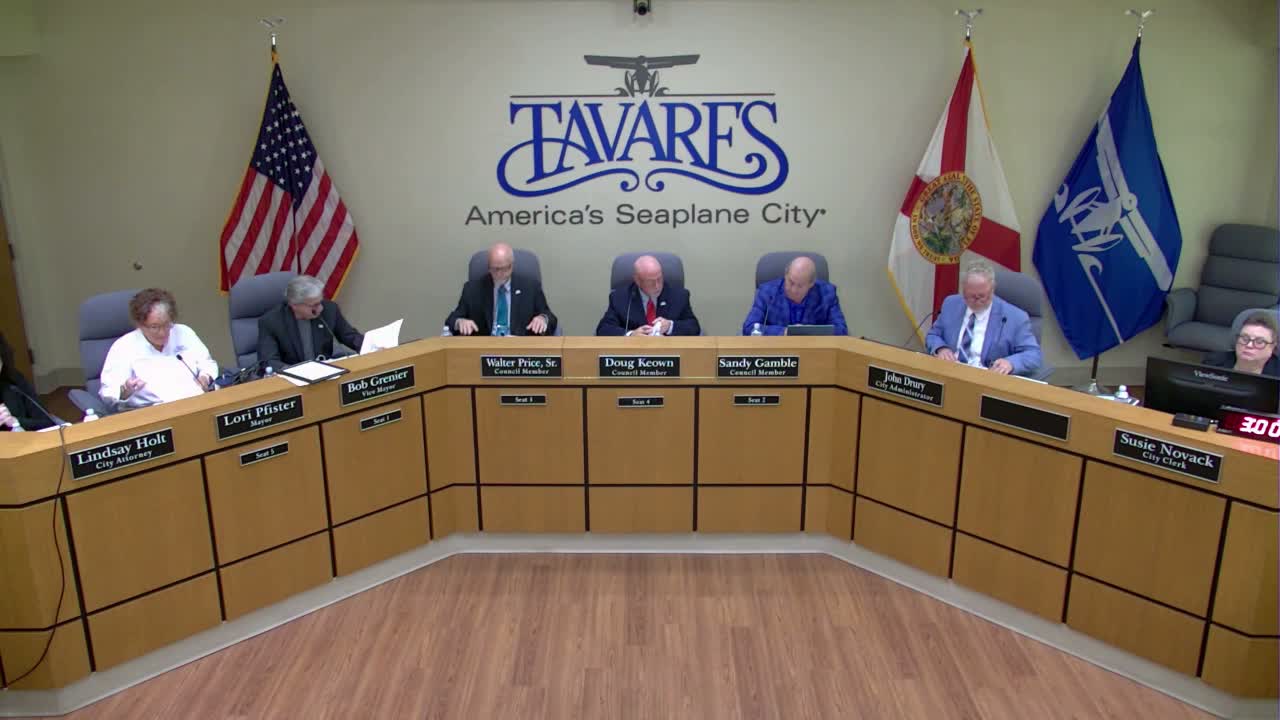
Tavares council adopts stormwater adaptation plan after unanimous vote
Summary
The Tavares City Council on May 6 accepted a final stormwater vulnerability assessment and unanimously approved a draft adaptation plan aimed at prioritizing projects and positioning the city to pursue grant funding under Resilient Florida and other programs.
The Tavares City Council voted unanimously May 6 to accept a final stormwater vulnerability assessment and to adopt a draft adaptation plan that ranks and prioritizes the city’s most flood‑sensitive assets, staff said.
Amanda Boone, senior project manager with Woodard & Curran, told the council the assessment examined six planning scenarios — including present‑day and future horizons through 2050 and 2080 — and modeled precipitation depths that "range from anywhere of 10.4 inches in the current 100‑year event all the way to over 19 inches in the 500‑year future year event." She said the team assigned consequence‑of‑failure and sensitivity ratings so the city can focus limited funds on critical infrastructure such as emergency operations, utilities and key road segments.
"We look at those future planning horizons so that when you're doing the design you can consider that future planning horizon," Boone said, explaining why the analysis extends decades ahead.
The adaptation plan lays out regulatory and citywide strategies as well as project options for individual assets — for example, floodproofing, elevating or relocating a vulnerable lift station — and attaches a numerical prioritization that favors city‑owned assets, shorter planning horizons and higher sensitivity ratings. Boone said the priorities are advisory and may be moved by the council when particular grant opportunities or projects are presented.
Council members asked how ownership affects eligibility for grants; staff and the presenter explained that if an asset is county‑ or state‑owned the county or state would typically be the grant applicant, and private ownership limits direct city applications. "Projects that benefit multiple assets are ranked higher than those that only benefit a singular asset," Boone said, noting that focusing on multi‑benefit corridor projects can strengthen grant competitiveness.
A council member moved to accept the vulnerability assessment and later moved to proceed with and approve the adaptation plan. Both motions carried by a 5‑0 vote. Council directed staff to return with specific project proposals and to work with Lake County to incorporate the city's vulnerability and adaptation priorities into the county mitigation strategy (LMS) to unlock additional mitigation funding.
Next steps include presenting individual projects with recommended priority rankings when staff seeks grant funding, and refining the prioritization as projects are developed and funding sources identified.