Get Full Government Meeting Transcripts, Videos, & Alerts Forever!
Get email alerts on the Lead Eligibility Alignment topic
No spam. Unsubscribe anytime.
CMS Innovation Center outlines LEAD ACO eligibility, beneficiary alignment and application timeline
Summary
CMS Innovation Center officials described the LEAD model’s goals, who may participate, new beneficiary alignment options including a hybrid approach, high‑needs criteria that can lower minimums, overlaps rules with other Medicare ACO programs, and an application deadline of May 17.
The Centers for Medicare & Medicaid Services (CMS) Innovation Center on a public webinar described the LEAD ACO model as a nationwide, 10‑year voluntary pilot that will run from Jan. 1, 2027, through Dec. 31, 2036, and aims to broaden accountable care organization (ACO) participation, improve care for high‑needs beneficiaries and increase patient choice.
"LEAD is designed to address these barriers by offering enhanced, flexible cash flow payments in addition to greater freedom and tools to support ACOs," said Lucy Sola, model co‑lead at the CMS Innovation Center. Sola said the model seeks to include small, rural, independent providers and community health centers that have historically faced hurdles to ACO participation.
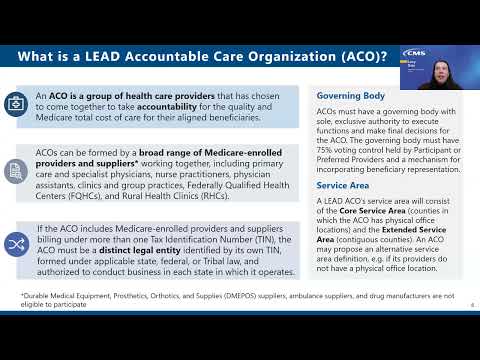
Under LEAD, an ACO must be a distinct legal entity with its own taxpayer identification number (TIN) and a governing body with 75 percent of voting control held by participant or preferred providers. Sola said ACOs must also include a mechanism for beneficiary representation.
The model provides two alignment mechanisms. Claims‑based alignment uses a one‑year look‑back on qualifying claims; voluntary alignment lets beneficiaries choose a provider affiliated with an ACO. Applicants may choose a prospective alignment approach (no mid‑year updates) or a new hybrid alignment that allows limited mid‑year updates: voluntary alignment updates monthly and claims‑based alignment updates once mid‑year for newly added participants.
Sola said beneficiaries added during a mid‑year claims update are aligned "from that point forward," and that added beneficiaries cannot be dropped during the performance year and must not overlap with other CMS models.
LEAD includes provisions to lower alignment minimums for certain ACOs. To qualify for reduced minimums, an ACO must either serve more than 40 percent high‑needs beneficiaries as defined by CMS or meet criteria for "newly entering" status: the ACO entity must not have previously participated in the Shared Savings Program or ACO REACH, fewer than 40 percent of its participants may have prior Shared Savings or REACH experience in the past five years, and fewer than 50 percent of participant providers may have prior Medicare ACO participation in the last five years.
CMS specified the high‑needs definition for counting toward the 40 percent threshold. High‑needs beneficiaries include those with a prospective risk score greater than 3 (or an ESRD risk score over 0.35), certain mobility‑impairing ICD‑10 codes, a Kim claims‑based frailty index above 0.35 or qualifying durable medical equipment claims, 45 or more Medicare‑covered skilled‑nursing facility days in the prior 12 months, or beneficiaries with 2+ unplanned hospital admissions combined with a risk score in the 2–3 range.
Sola also described preliminary overlaps policy guidance: an individual beneficiary may be aligned to only one ACO/shared‑savings model per performance year; LEAD participants cannot concurrently participate in the Shared Savings Program or other Innovation Center models with shared‑savings components; preferred providers may participate in more than one LEAD ACO in limited circumstances.
Applications are available on the LEAD model webpage and are due by May 17 at 11:59 p.m. Eastern. Meredith Yinger, co‑model lead, said selected applicants will be notified by early summer 2026, selected ACOs must upload participant TINs into the 4i platform by Aug. 5, 2026, make any TIN drops by Sept. 8, 2026, may use an optional implementation period from Sept. 15–Dec. 15, 2026, and the model launches Jan. 1, 2027.
The webinar included a question‑and‑answer period addressing overlap deadlines, hybrid alignment timing, and eligibility for lower minimums; CMS will post a recording, transcript and FAQs on the model webpage and respond to remaining questions via lead@cms.hhs.gov.