Get Full Government Meeting Transcripts, Videos, & Alerts Forever!
Get email alerts on the Utilities Budget topic
No spam. Unsubscribe anytime.
Brainer Public Utilities budget approved; council signs off on lead‑service funding and large water and wastewater projects
Summary
The Brainerd City Council approved the Brainer Public Utilities 2026–2030 operating and capital plan, including $2.5 million in lead service line replacement funding for 2026 and multi‑million-dollar projects that stage a future $58 million water treatment facility and a wastewater expansion budgeted at $24 million over 2026–27.
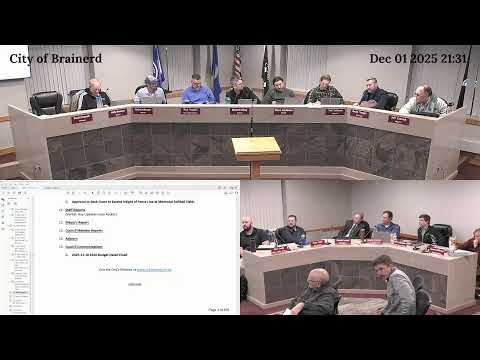
The Brainerd City Council on Dec. 1 approved the Brainer Public Utilities (BPU) operating and capital plan for 2026–2030 after a presentation from utility staff that outlined major infrastructure investments and near‑term funding needs.
Mr. Sandy, BPU’s capital presenter, told the council the electrical program includes ongoing overhead and underground work and a $2.5 million downtown substation project programmed for 2029. He said hydro facility modernization — including a two‑year generator replacement project — is budgeted at $4.85 million in 2028–29. For water, staff programmed $2.825 million in 2026–27 for a reclamation and backwash tank and identified a new Well 9 at an estimated $5 million set for 2027. The plan also stages costs in 2028 and 2030 that align with previous estimates for a future water treatment plant of roughly $58 million.
Finance manager Danny Lock presented the operating side, saying the combined 2026 budget shows total revenues of about $40.3 million and total expenses of about $40.08 million, leaving a modest positive change in net position. “That’s kind of supporting the system reliability,” Lock said, and noted the budget reflects previously approved January 1 rate adjustments and a plan to build reserves for capital work.
On a widely anticipated issue, Sandy and Lock said the city will receive just over $2.5 million in external funding in 2026 for lead service line replacements; staff said additional external funding is expected in future years through the Minnesota Department of Health program. Lock also told council the wastewater capital program includes two years of work totaling about $24 million (roughly $12 million in 2026 and $12 million in 2027) to address plant expansion, biosolids improvements and storage capacity.
After questions from councilmembers about timing, hydrogeneration offsets and a cost‑of‑service rate study (budgeted at $60,000), Councilmember Chzach moved to approve the BPU operating and capital budget; Bevans seconded. The motion passed on a council vote.
What happens next: Staff will implement the budgeted projects and return to the council and relevant boards as required for project‑level approvals, bonding and grant administration. Several large capital projects are contingent on state funding and low‑interest loan eligibility, which staff said are being pursued as part of ongoing project planning.