Get Full Government Meeting Transcripts, Videos, & Alerts Forever!
Get email alerts on the Street Reconstruction topic
No spam. Unsubscribe anytime.
Brainerd committee backs staff plan for 2026 Southeast Brainer reconstruction: pave Laurel, remove gravel block on Maple, add sidewalks
Summary
Engineer Dean presented options for the 2026 Southeast Brainer reconstruction project; the committee approved staff recommendations to pave Laurel between 17th and 18th, remove about two-thirds of the gravel block of Maple between 18th and 19th to combine wetlands, and extend sidewalks on Norwood and other short links, with the city covering sidewalk costs.
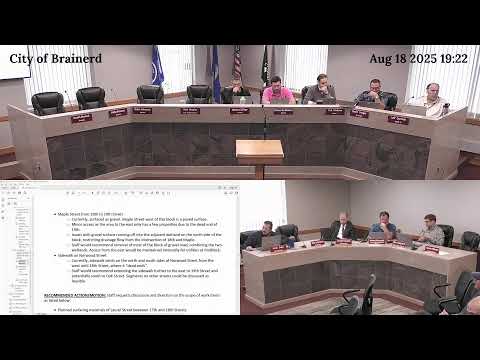
The Brainerd City Safety and Public Works Committee approved staff's recommended scope for the 2026 Southeast Brainer reconstruction project, which includes paving Laurel Street between 17th and 18th, removing roughly two-thirds of the gravel block of Maple Street between 18th and 19th to combine wetlands and reduce gravel wash, and installing or extending sidewalks on Norwood and nearby blocks.
Engineer Dean described the project area as a small neighborhood north of Oak including 17th and East and said staff's recommendations target maintenance, stormwater treatment and resident access. On Laurel Street, staff recommended paving a narrow one-way gravel segment to improve access and reduce storm runoff. On Maple Street, Dean said the gravel block between 18th and 19th creates maintenance and stormwater problems; staff proposed excavating most of that block to combine two wetlands and reduce gravel washing into the wetland. "We would recommend maybe leaving about a third of it to provide access to maintained properties and to preserve access to a three-phase power cabinet," Dean said.
Council members also questioned sidewalk placement and property impacts; Dean said right-of-way constraints make one-side sidewalk installation preferable in some locations and confirmed the city typically covers sidewalk construction costs in this type of reconstruction project. The staff recommendation included options to minimize property impacts (for example, one-side sidewalks rather than both sides where retaining walls or steps would be required).
A council member moved to follow staff recommendations for the three scope elements; the motion was seconded and approved by voice vote. Staff will present the recommended scope and plans to area residents at the neighborhood meeting and continue design work with the ability to adjust the project through design if needed.