Get Full Government Meeting Transcripts, Videos, & Alerts Forever!
Get email alerts on the Data Internship topic
No spam. Unsubscribe anytime.
NLM’s data internship opens for library graduate students; 9 paid slots, runs June 1–Aug. 7
Summary
The National Library of Medicine’s National Center for Data Services is accepting applications through April 30 for a paid, fully remote data internship for library graduate students. Up to nine interns will be placed at three host sites; selected candidates will be notified by May 11.
Justin Dela Cruz, associate director of the National Center for Data Services at the National Library of Medicine, told attendees the center is accepting applications for a paid summer data internship aimed at library graduate students.
The fully remote internship runs June 1 through Aug. 7, pays a total stipend of $2,000 (about 10 hours per week at $20 an hour), and will place up to nine interns across three host sites in teams of three, Justin Dela Cruz said. "This internship is fully online," he said, adding the program combines individual data projects with regular professional-development sessions offered by NCDS.
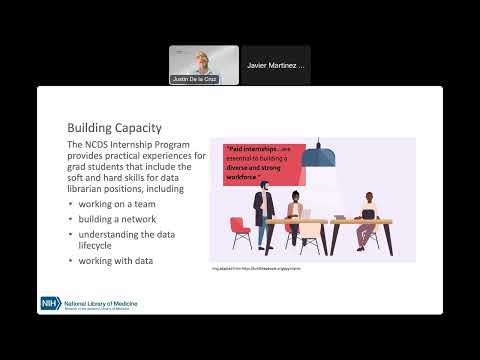
The program pairs each intern with a mentor at a host site — typically a data librarian at a university or research institute — and expects interns to complete an individual project, produce a written project report and give a short presentation to the cohort. "These paid internships offer opportunities to gain practical experience while working with a mentor in a guided environment on structured data related projects," Justin Dela Cruz said. He emphasized that the program prioritizes professional development over publishable research outputs.
A former intern on the panel, Javier, urged eligible students to apply. "It really gave me a really good head start for my career after I finished library school," he said, describing the internship as a chance to gain hands-on data experience and professional connections.
Eligibility requirements include current or recent enrollment in a library/information studies graduate program (defined as graduating in spring 2025 or later) and U.S. citizenship or permanent residency. Applicants must submit the online application form, a statement of interest and a CV or resume; the application window is open now and closes April 30. Organizers intend to notify selected applicants by May 11 and finalize host-site placements in May ahead of the June 1 start.
The internship includes two main components: (1) an individual data project at a host site with a mentor, and (2) NCDS-run professional-development sessions that may cover technical tools (R, Python, APIs), visualization, data curation workflows and job-search preparation. Justin Dela Cruz said sessions are typically heavier in the first two or three weeks (about three to four group hours in that period), with more independent work later; meetings will be recorded for trainees who cannot attend live.
Organizers said the internship is federally funded through a grant and that application support is available: applicants may confidentially consult Nagin Agosbeck, a data visualization librarian at the University of Washington, for advice on application materials. An example from 2024 highlighted interns working with the Data Curation Network on job-posting analyses, using tools such as Tableau and OpenRefine, and producing varied deliverables including readme documentation, visualizations and salary analyses.
Those with questions can contact the center at ncds@nlm.gov. The webinar recording and slides will be posted online for later review.