Get Full Government Meeting Transcripts, Videos, & Alerts Forever!
Get email alerts on the Battery Storage topic
No spam. Unsubscribe anytime.
Developer pitches 250 MW battery-storage site in Hurley; legislators press on fire risk, jobs and host benefits
Summary
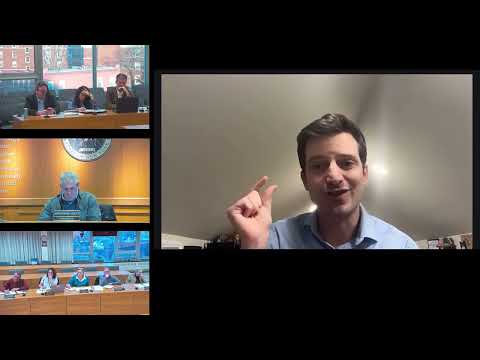
Teren representative Mark Turner presented a proposal for a 250 MW lithium‑ion battery energy storage facility at 430 Hurley Avenue in the Town of Hurley near Central Hudson’s Hurley substation. Legislators pressed the developer on past fires at other sites, emergency response, contamination testing, local jobs, host-community benefits and tax/utility impacts; the company said two fires occurred across nine operating sites and that EIR materials and large‑scale fire test reports will be part of the review.
Mark Turner, representing developer Teren, described a proposed 250-megawatt lithium‑ion battery energy storage project sited at 430 Hurley Avenue (the former John A. Coleman Catholic High School) in the Town of Hurley. Turner said the project footprint would occupy roughly 15 acres within a 25-acre property, with modular, compartmentalized enclosures arranged to meet New York State Fire Code and NFPA guidance and with minimum 100‑foot setbacks to qualify as a “remote outdoor facility.” He emphasized grid reliability benefits: the facility is designed to manage peak demand, stabilize voltage and reduce transmission congestion by locating capacity near load, and can participate in state procurement processes such as NYSERDA/NYISO solicitations.
Legislators focused much of their questioning on safety and community impacts. Legislator Stewart and others raised that Turner’s operator had experienced two fire events at two of nine operating sites; Turner confirmed two incidents since operations began in 2020, saying each fire was limited to a single enclosure or a few modules and that air, soil and water monitoring at those sites showed no contamination beyond standards. Turner said manufacturers perform large-scale fire testing using the same configuration proposed for the site, that emergency response plans and first responder training would be provided, and that the EIR (environmental review) will include representative large-scale fire test results, monitoring data and an emergency response plan.
On liability, Turner said remediation and cleanup would be the developer/operator’s responsibility and that the credible event during testing is limited to one enclosure, comparable to a structural shed fire in terms of cleanup scope. On jobs and local economic impact, Turner estimated about 110 full‑time-equivalent union construction jobs during the building phase and said there would be limited permanent on-site staffing after construction (routine O&M visits). He said the project intends to negotiate a host-community benefit agreement with the Town of Hurley but had not finalized terms and did not provide details on local hire guarantees.
Residents and legislators raised other concerns: whether the county could be financially liable in a major incident (developer said remediation is the operator’s responsibility); whether hazardous combustion byproducts (including HCN) are generated (developer said HCN is common to many structural fires and that monitoring of past events did not show public health exceedances); spacing and access for firefighting equipment (Turner said 100-foot setbacks and tested enclosure designs are intended to allow containment and firefighter actions); and potential noise and visual impacts (Turner said the project will meet noise standards at property boundaries and that landscaping/walls reduce view impacts).
What’s next: the developer said a SEQRA/EIR process will provide fuller site plans, large‑scale fire test reports, emergency response plans, noise and traffic studies, and draft host benefit proposals. Committee members asked for the developer’s monitoring/test data from the two prior fire events and for follow-up meetings with first responders and environmental staff.
Attribution note: direct quotes and numerical claims (two fires at two of nine operating sites; 110 full‑time-equivalent construction jobs) are attributed to Mark Turner and have been presented exactly as he described them during the committee discussion.