Get Full Government Meeting Transcripts, Videos, & Alerts Forever!
Get email alerts on the Cdbg Process topic
No spam. Unsubscribe anytime.
Hartford officials outline CDBG timeline and tighter grant rules ahead of May deadline
Summary
City grants director Cheryl Harowitz told the council that HUD entitlement funds and a shortened schedule require timely submission of the 2026 annual action plan; she warned that requests far exceed available CDBG dollars and described new past-performance checks and monitoring to reduce compliance risk.
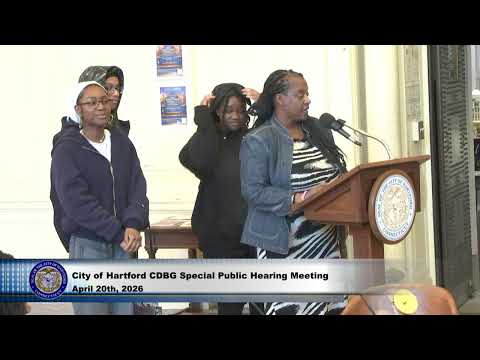
Council President TJ Clark convened a public hearing on April 20, 2026, where Cheryl Harowitz, director of the Office of Grants for the City of Hartford, summarized the city's Community Development Block Grant (CDBG) process and urged timely submission of the 2026 annual action plan to meet HUD deadlines.
Harowitz said the planning process began in January and runs through May, with a second public comment session scheduled for April 29. She told the council that submitting the draft on time would allow the city to receive HUD funding sooner, speeding contract awards and project starts.
The city receives formula entitlement funds from the U.S. Department of Housing and Urban Development for CDBG and three related programs: the Housing Opportunities for Persons With AIDS program, the Emergency Solutions Grant for people experiencing homelessness, and the HOME Investment Partnerships program. Harowitz said the city conducts a five-year consolidated planning process and issues an annual action plan each year within that framework.
Harowitz reviewed eligibility categories for CDBG (housing, public services, public facilities/infrastructure and parks/open spaces) and reminded the council that federal rules cap CDBG spending on public services at 15 percent of the allocation. She said public-service requests 'including food pantries, workforce programs and wraparound supports'were often the most visible but also the most constrained by that statutory limit.
The director reported that entitlement funding has declined from 2023 through 2026, with a pronounced drop in HOME program dollars because those projects often require longer construction timelines and slower draws. The grants office recycled roughly $62,000 into economic-development activities this year from returned or unspent awards, Harowitz said.
To reduce program risk, the city added a five-part past-performance assessment to applications this cycle. The evaluation covers whether contracts were executed in a reasonable time, whether drawdowns were performed with regularity, whether subrecipients followed direction and provided accurate documents, whether accomplishments matched proposed goals, and whether final reports were submitted promptly. Harowitz warned that poor documentation or incomplete beneficiary records can trigger HUD review and potential repayment obligations for the city.
Given high demand, Harowitz said the office adopted an internal practical-minimum award of about $10,000 to ensure funded projects are viable rather than token allocations that cannot deliver meaningful outcomes. She also outlined monitoring responsibilities and noted that the onerous citizen-verification requirement is currently on hold and that federal "Buy America" construction-product rules were being revisited.
Council President Clark explained that the draft action plan would be posted to the grants office website and available for at least 30 days for public review through May 14, with additional materials (anonymized score sheets and reviewer comments) available to council members on request. A council member asked when the administration would transmit recommended allocations; Harowitz said reviewers'comments and application folders would be accessible and that staff would provide requested score sheets.
The hearing closed with a reminder of the May 15 federal submission deadline for the city's annual action plan.