Get Full Government Meeting Transcripts, Videos, & Alerts Forever!
Get email alerts on the Short Term Rentals topic
No spam. Unsubscribe anytime.
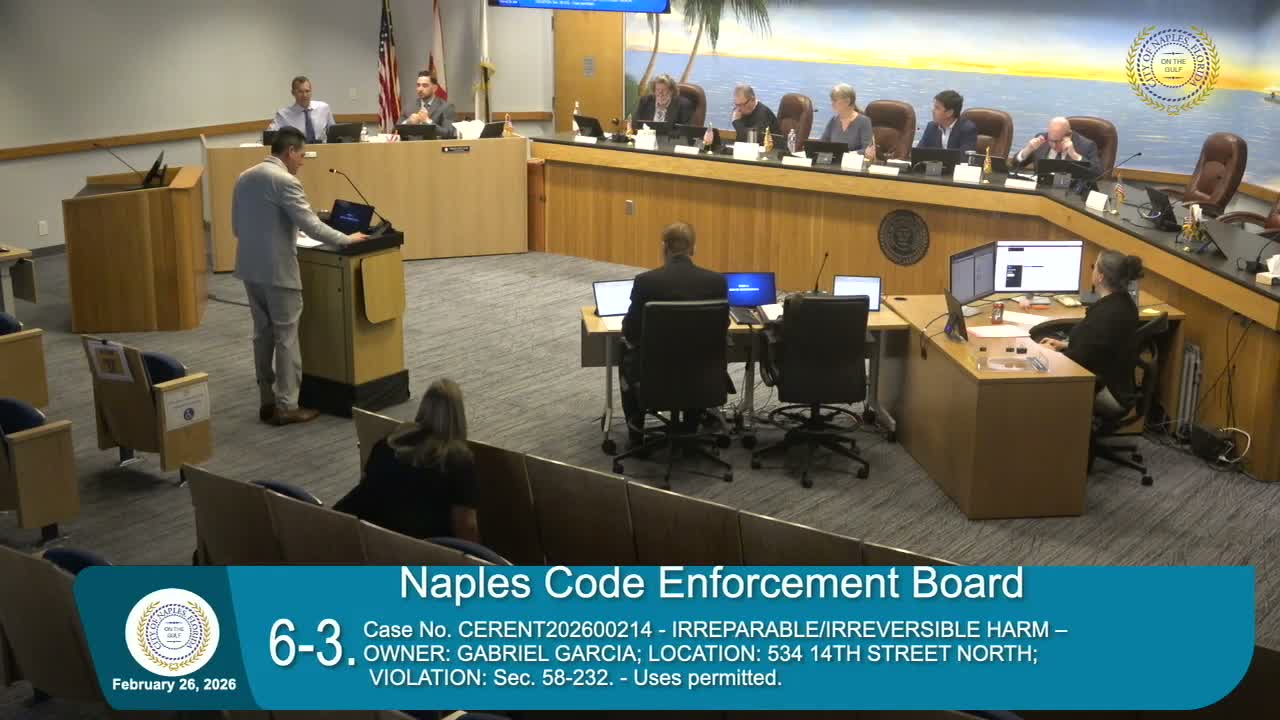
Naples board finds short-term rentals at 534 14th St. N. and imposes $4,800 fine
Summary
The Code Enforcement Board found a Naples property at 534 14th Street North violated the city's short-term rental rules for documented stays under 30 days in 2025 and imposed a $600-per-occurrence fine (eight occurrences, $4,800 total) plus administrative costs.
The Code Enforcement Board of the City of Naples on Tuesday found that a homeowner violated the city's short-term rental rules by permitting multiple stays of less than 30 days in 2025 and imposed a $4,800 fine.
Bill Quincy, the city's co-compliance manager, told the board staff had documented 11 total stays in 2025, of which 8 exceeded the three-stays-per-year exception and therefore constituted violations. "So part of that too, is we also get a list of those properties that did get letters," Quincy said, summarizing the city's evidence and noting screenshots and guest reviews that showed multiple short stays.
Respondents Gabriel and Andrea Garcia, who own 534 14th Street North, said they received an informational letter in December, updated their Airbnb listings to a 30-day minimum on Dec. 26 and later discovered a separate listing had reverted to a two-night minimum because of a platform glitch. "In summary, the property is currently in full compliance," Gabriel Garcia told the board and submitted an affidavit documenting when the listing was changed.
Board members pressed the owners and staff for documentation of revenue from the short stays. Estimates offered during testimony varied; the Garcias, under oath, gave a working estimate of roughly $3,200 net for the eight stays but said they had issued some refunds and recorded net losses for the property in recent tax filings. City staff said the law allows fines ranging up to $5,000 per violation and provided a rough revenue-calculation framework for the board to consider when setting a penalty.
After debate over how to calculate an appropriate deterrent fine, a motion to adopt staff's proposed order imposing $2,000 per violation (totaling $16,000) failed. The board then approved a reduced penalty of $600 per occurrence, for eight violations, totaling $4,800; the motion passed on roll call (four in favor, one opposed). The order includes administrative enforcement costs described in staff testimony.
The board's counsel reminded members they must weigh statutory factors specified in chapter 162's framework (gravity of the violation, corrective action by the violator and prior violations). Members cited the owners' remedial steps and the relatively modest nightly rates at the property when settling on a lower fine.
The board recorded that the owners had come into compliance before the hearing and noted the fine and costs were intended primarily as a deterrent. The finding and fine will be memorialized in a written order provided to the parties.
The case began as docket item 6.3 and concluded with the board's vote to impose the $4,800 penalty and associated costs.