Get Full Government Meeting Transcripts, Videos, & Alerts Forever!
Get email alerts on the Fiscal Impact Ordinance topic
No spam. Unsubscribe anytime.
Norwalk committee advances draft ordinance requiring fiscal-impact statements for new or amended laws
Summary
The Ordinance Committee voted to send a draft ordinance to public hearing that would require departments to prepare fiscal-impact statements describing staffing, operational and capital effects when a city ordinance is proposed or amended; members asked for clearer definitions of “significant amendment,” a standardized departmental template and a grace period for departments to prepare.
The Norwalk City Ordinance Committee on March 17 voted to send a proposed ordinance requiring fiscal-impact statements to a public hearing, after an extended discussion about scope and implementation.
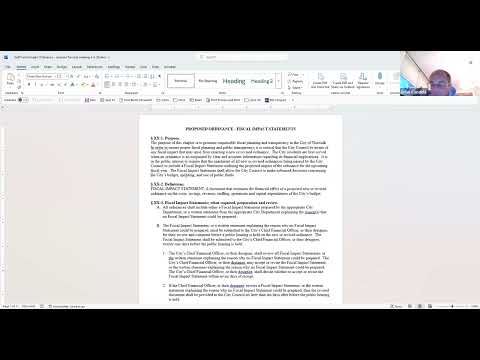
Staff presented a draft that would require departments to attach a fiscal-impact statement describing potential effects on staffing, operations and capital expenditures before ordinances or substantive amendments are considered. "This is a strong, well-structured ordinance," one council member said, and staff noted the draft already includes a requirement to state potential staffing impacts in the upcoming fiscal year.
Council members raised several implementation questions. President Josh Goldstein said he was unsure about wording in the draft that refers to a “significant amendment,” asking, “I don't know what 'significant amendment' means.” Members worried an unclear definition could be used to delay legislation. Others proposed procedural safeguards: allow a two-thirds vote to waive a new fiscal-impact statement for late-floor amendments; require the CFO to review department submissions when multiple departments are affected; and attach all fiscal statements to public hearing backup materials.
Brian (staff) said the fiscal-impact statements are intended as guidance, not binding constraints, and urged early department engagement so leaders can estimate likely costs. Committee members recommended outreach to department heads and the CFO to develop a standardized, high-level template and to consider a delayed effective date (examples discussed: a June start with full effect Jan. 1) to give departments time to prepare.
The committee did not adopt the ordinance that night; members asked staff to revise the draft with clearer definitions, a proposed template and an implementation timeline. The item was moved to a public hearing in April.