Get Full Government Meeting Transcripts, Videos, & Alerts Forever!
Get email alerts on the Emergency Medical Services topic
No spam. Unsubscribe anytime.
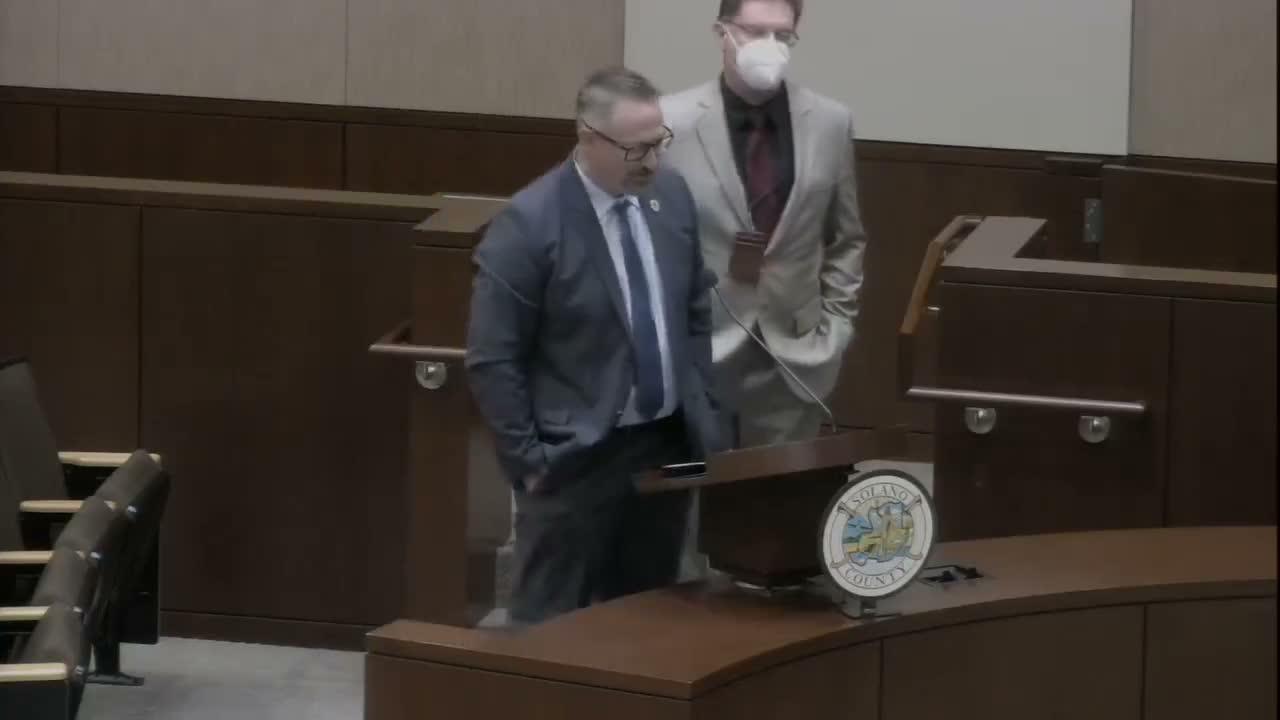
Solano County votes to withdraw from regional EMS JPA, delays advisory committee pending more data
Summary
The board adopted a resolution to withdraw from the Solano Emergency Medical Services Cooperative JPA and voted to delay forming the county’s new Local EMS Agency advisory committee until staff returns with comparative models and additional information; the withdrawal begins a 12‑month notice process.
The Solano County Board of Supervisors on May 12 adopted a resolution to begin withdrawal from the Solano Emergency Medical Services Cooperative (SMSC) Joint Powers Authority and directed staff to return with more information before finalizing the membership and voting structure of a new Local EMS Agency (LEMSA) advisory committee.
Benjamin Gammon, Solano County EMS administrator, told the board the LEMSA’s state‑mandated duties include overseeing 24/7 ambulance coverage, setting medical standards, monitoring quality and ambulance patient‑offload time, and coordinating hospitals, dispatch, fire and public health. “State law requires the LEMSA … to ensure a safe reliable 911 EMS system by overseeing 24/7 ambulance coverage, setting medical standards and coordinating across EMS, fire, hospital, dispatch, public health and law enforcement,” Gammon said.
Gammon said the county’s exclusive operating area (EOA) contract with Medic Ambulance is under a solicitation (RFP) that reopened in early May; he advised the board the current provider agreed to an extension through Dec. 1 to avoid service gaps while the procurement proceeds.
Public comment and several supervisors pressed the question of who should vote on advisory‑committee recommendations. A member of the public objected to excluding ambulance transport providers from voting: “Excluding the ambulance providers from voting participation is a significant omission,” the commenter said, urging the board to include operational providers as voting members so the committee benefits from frontline data on response reliability and offload delays.
In debate, supervisors weighed two concerns: the operational expertise transport providers bring to system planning, and the need to avoid conflicts of interest where a contracted provider could influence procurement or compensation decisions. Supervisor Mashburn warned about the perception of conflicts; another supervisor proposed allowing only the contracted EOA provider to serve as a voting member while that contract is in force.
The board voted 4–0 to adopt a resolution announcing the county’s intent to withdraw from the SMSC JPA (the process requires 12 months’ notice). On a subsequent motion to postpone forming the new advisory committee until staff returns with comparative models and additional data, the board approved the delay 3–1 (Supervisor Mashburn voting no). The board asked staff to provide examples of advisory‑committee structures used in other counties and to propose quarterly reporting metrics for EMS performance (stroke, STEMI, CARES cardiac arrest survival, and ambulance patient offload time).
Next steps: the county will publish formal notice of withdrawal from the JPA, continue administering LEMSA functions during the 12‑month period, and staff will return with a proposal for advisory‑committee composition and best practices drawn from peer counties during a later board meeting.