Get Full Government Meeting Transcripts, Videos, & Alerts Forever!
Get email alerts on the Water Quality topic
No spam. Unsubscribe anytime.
Committee members urge workshop and certification to curb nutrients in Venetian Bay
Summary
Committee members pressed for more frequent water-quality reporting and proposed a workshop and landscaper certification program after staff said Venetian Bay is impaired for nutrients; staff described current testing protocols, annual costs (~$22,000), limits on pesticide regulation and past successful BMP/landscaper training programs.
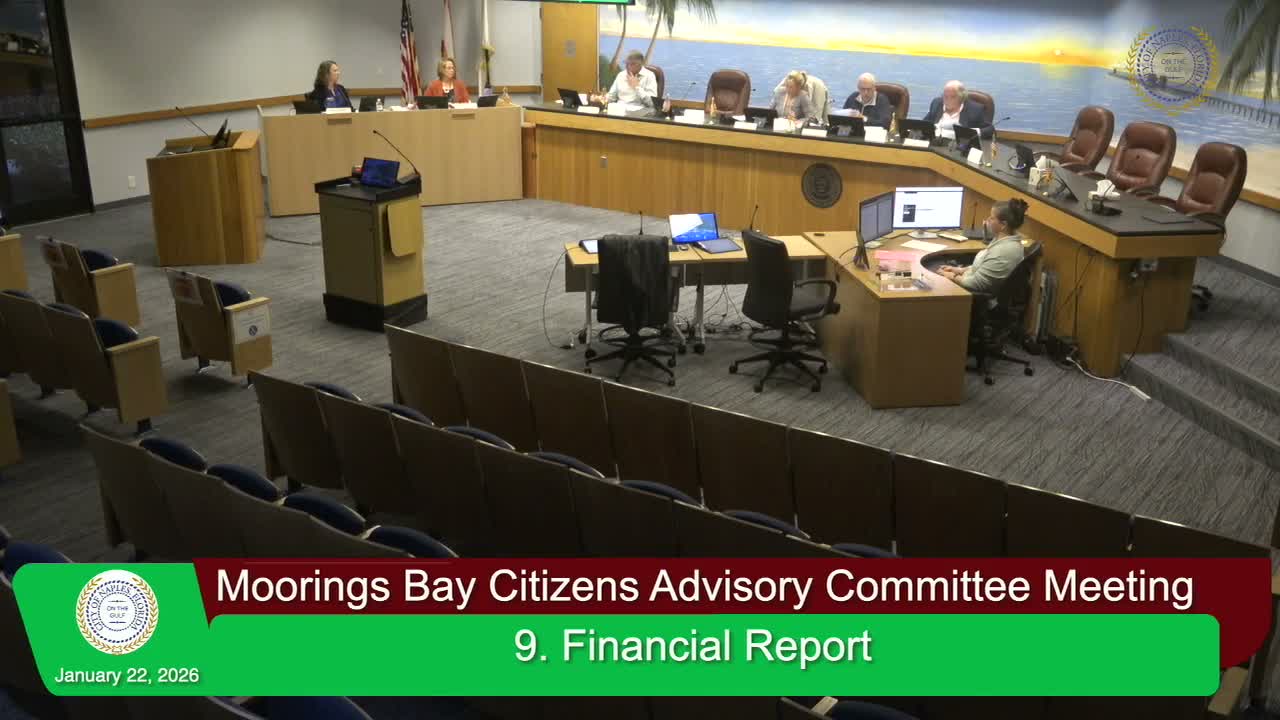
Committee member Cindy and others told the Mornings Bay Citizens Advisory Committee on Jan. 22 that nutrient levels in Venetian Bay are rising and that the committee should consider a workshop or a landscaper-certification program to reduce runoff from lawns and landscape spraying.
"Every year, we're increasing in these pollutants," Cindy said, urging more frequent reporting than the current five-year synthesized trend and proposing a workshop that would include landscapers, HOAs, IFAS, Rookery Bay and county staff to develop a 'bay safe' program or incentives.
Staff (Katie Lachinen) said the city pays about $22,000 a year for monthly sampling at four Venetian Bay sites and that samples include nutrients, bacteria and metals used by the state (DEP) for impaired-waters assessment; staff said glyphosate is not part of the routine estuary parameter list and that testing for that compound may not be common or informative in an estuarine/diluted context. Lachinen also explained the data-quality process—quarterly uploads to the state Watershed Information Network and multi-step QA/QC—meaning synthesized trend analysis is typically presented every five years to provide robust statistics.
Lachinen reminded the committee of an earlier city-developed landscape certification (BMP) program that later became the model for a statewide program and suggested outreach and microgrant approaches (for littoral plants, for example) as options to encourage alternative practices. She cautioned that local governments have limited authority to regulate pesticides (the "label is the law" enforced by the Florida Department of Agriculture and Consumer Services) but said outreach and incentive programs can change behavior.
The committee asked staff and volunteers to identify one to three tangible action items and return with a progress report at the next meeting.