Get Full Government Meeting Transcripts, Videos, & Alerts Forever!
Get email alerts on the Home Care Nursing Cap topic
No spam. Unsubscribe anytime.
Parents, advocates and sponsor press committee to clarify law after insurers cap private-duty nursing
Summary
Parents of medically complex children told a Minnesota conference committee that insurers have reclassified continuous private‑duty nursing as brief 'visits,' leaving children hospitalized and families appealing; a sponsor said a statutory clarification would restore 2010 intent and prevent cost‑shifting to Medicaid.
Parents of medically complex children urged members of a Minnesota conference committee to adopt a statutory clarification after commercial insurers this year began limiting coverage for continuous private‑duty nursing, testimony showed.
"Medica began referring to Gwen's 24 hour a day ICU level care as visits," said Nick Keys, who identified himself as the father of a 5‑year‑old, Guinevere. Keys told the committee his daughter was hospitalized March 3 and that "Medica's coverage cap took effect on March 31," reducing an assessed need of 127 hours per week to "240 hours per year," which he said "is not enough to keep a child like my daughter alive and safely at home."
Emily Walters, mother of a medically complex 5‑year‑old, described continuous private‑duty nursing as "not intermittent care" and "not visit based," saying the service is "a hospital level service delivered in the home." Walters said families rely on consistent nursing to maintain employment and keep children out of hospitals.
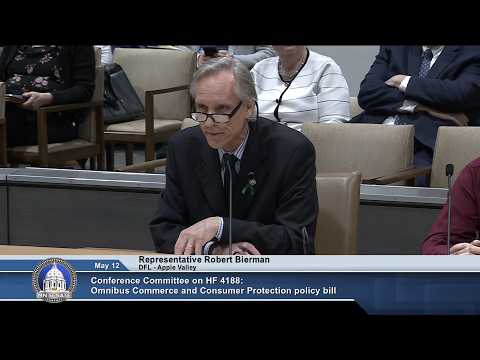
Representative Bierman, who urged the committee to adopt a clarification, told members the proposal "is not a new mandate and does not add costs to the commercial plans or to the state budget if we adopt it," and that the bill would close a perceived loophole in the 2010 law so that commercial plans remain responsible for home care nursing for people on medical assistance who also carry commercial coverage.
Nonpartisan staff explained the statutory language cited by speakers is found in the mandate provision (section 62Q.545) and noted the definition inserted into paragraph (e) describes ongoing, continuous nursing ordered by a physician, APRN or PA and provided by an RN or LPN when care "cannot be safely or effectively met through intermittent, episodic, or visit based nursing services."
Parents and the sponsor framed the issue as a practice shift by insurers and an enforcement gap at the Department of Commerce. Keys said his family had to appeal first to the insurer and then to the Department of Commerce and that he and other families "have been scrambling to figure out how we can safely bring our daughter home from the hospital." He also told the committee a hospital bill for 10 days (March 15–26) was $246,000, which he offered as an example of the cost consequences of lost home nursing.
Committee members asked staff for statutory language and clarification on billing and definitions. No final vote or formal committee action was recorded in the transcript; the sponsor asked the committee to include the clarification in the conference report.
The committee is scheduled to meet tomorrow to consider motions and possible adoption of the conference committee report.